
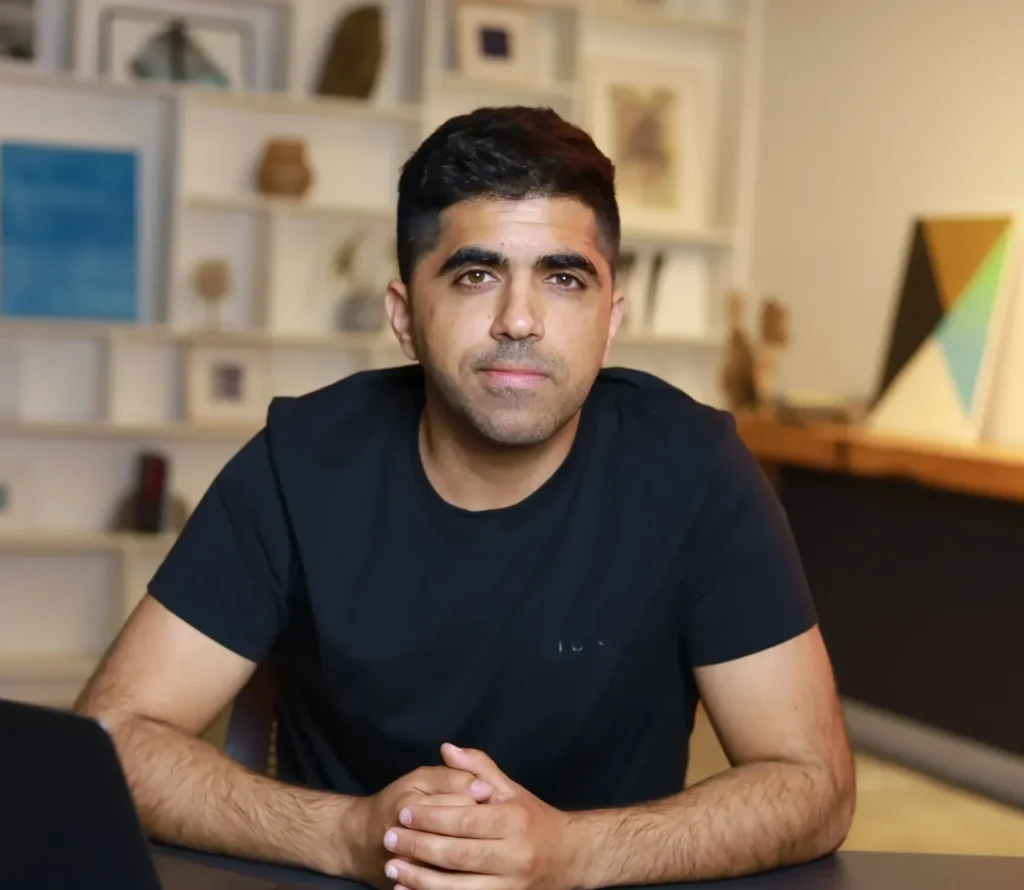
Uptin Saiidi, Building Trust in a One-Minute World
Uptin Saiidi, Building Trust in a One-Minute World By Bella Brown When Uptin Saiidi speaks about journalism, he does so without nostalgia. There is no romantic longing for the golden age of newspapers or the primetime authority of television anchors. Instead, his view is firmly rooted in the present—a media environment defined by speed, platforms, and an audience that no longer waits to be informed but expects to be engaged. In that world, Saiidi has emerged not as a disruptor chasing virality but as a journalist quietly adapting the craft to where attention has moved. Over the last decade, the mechanics of news consumption have fundamentally changed. Information no longer flows primarily from institutions to the public, but between individuals, across screens, in compressed bursts of video and commentary. Saiidi noticed this shift early, not as an abstract industry trend, but as a measurable reality playing out on social media feeds. He watched as individual creators, often working alone, began to outperform legacy media organizations on platforms that were becoming the primary source of news for millions. Their videos traveled faster, reached wider audiences, and—perhaps most importantly felt more personal. Viewers weren’t just consuming information; they were building relationships with the people delivering it. For Saiidi, this was not a sign that journalism was dying. It was a signal that it was evolving. Rather than resisting the change, he leaned into it. His transition from traditional journalism into short-form storytelling was not driven by frustration with old systems, but by a clear-eyed assessment of where influence was shifting. In a media ecosystem increasingly shaped by algorithms and audience behavior, credibility could no longer rely solely on institutional branding. It had to be earned, repeatedly, through consistency and clarity. That realization became the foundation of his work. Saiidi’s content spans technology, economics, business, culture, and global trends—subjects often perceived as complex or inaccessible. Yet his approach strips away unnecessary jargon without flattening nuance. The goal is not simplification for its own sake, but translation: taking subjects people already sense are important and helping them understand why. His process begins with curiosity. Rather than chasing headlines, he tracks broader patterns—emerging technologies, economic shifts, policy decisions—and asks a deceptively simple question: what would I want explained if I were encountering this for the first time? That instinct, he believes, mirrors the experience of his audience. In a world flooded with information, relevance is no longer about novelty alone. It is about resonance. Saiidi pays attention to what people are already talking about, confused by, or debating, and uses those signals to guide his editorial decisions. The topics he chooses are rarely arbitrary. They reflect his own desire to learn, under the assumption that genuine interest is difficult to fake and easy to recognize. This philosophy stands in quiet opposition to the prevailing obsession with virality. While short-form platforms reward speed and emotional hooks, Saiidi resists the impulse to let performance metrics dictate substance. If a story is compelling and accurate, he trusts that it will find its audience, even if it does not immediately explode. That trust is rooted in discipline. Fact-checking is non-negotiable. Context matters, even when time is limited. The compression demanded by short-form video does not absolve journalists of responsibility; it heightens it. With fewer seconds to speak, every sentence carries more weight. The tension between integrity and performance is one of the defining challenges of modern media, and Saiidi navigates it with a clear hierarchy of values. Accuracy comes first. Engagement follows naturally, not the other way around. When videos underperform, he does not default to blaming algorithms. Instead, he treats the data as feedback—useful, but not authoritative. His belief is simple but firm: algorithms reflect audience behavior. They do not create interest; they reveal it. For journalists willing to listen, they offer insight into what resonates and what does not. Despite his association with short-form media, Saiidi’s proudest work emerged from long-form reporting. His documentary on Bitcoin adoption in El Salvador required weeks of on-the-ground filming and extensive research. The project explored both the promise and the pitfalls of a national experiment that captured global attention. Rather than advocating a position, the documentary aimed to assess reality—what was working, what was not, and what the consequences might be. That experience reinforced a principle that continues to shape his workflow: short-form storytelling is most effective when built on deep reporting. In his model, long-form journalism provides the foundation, while short-form videos act as gateways. A one-minute clip does not replace a documentary; it invites viewers toward it. This layered approach addresses one of the most persistent criticisms of micro-journalism—that it sacrifices depth for speed. Saiidi does not deny the limitations of short-form formats. There is less time for nuance, less room for historical context, and fewer opportunities to explore competing perspectives within a single video. The solution, he believes, lies in selectivity. Not every angle belongs in every piece. Learning what to leave out is as important as deciding what to include. Sometimes, the most responsible choice is to acknowledge that a topic cannot be fully explored in sixty seconds and to point audiences toward longer work. This editorial restraint is a skill honed over time, and one he encourages aspiring journalists to develop. For those entering the field today, his advice is direct and unsentimental. Consistency matters more than perfection. Publishing frequently accelerates learning—not just about storytelling, but about audience expectations. Independence demands resilience. There is no editor assigning stories, no guaranteed distribution, and no institutional shield from failure. At the same time, there has never been more opportunity. Journalists no longer need permission to build an audience. Platforms reward individual voices, and trust is increasingly personal rather than institutional. Saiidi sees this shift playing out across the industry, as traditional reporters leave major outlets to establish their own brands, and creators secure interviews once reserved for legacy media. This decentralization has reshaped authority. News is no longer consumed at fixed times or through singular channels. It