

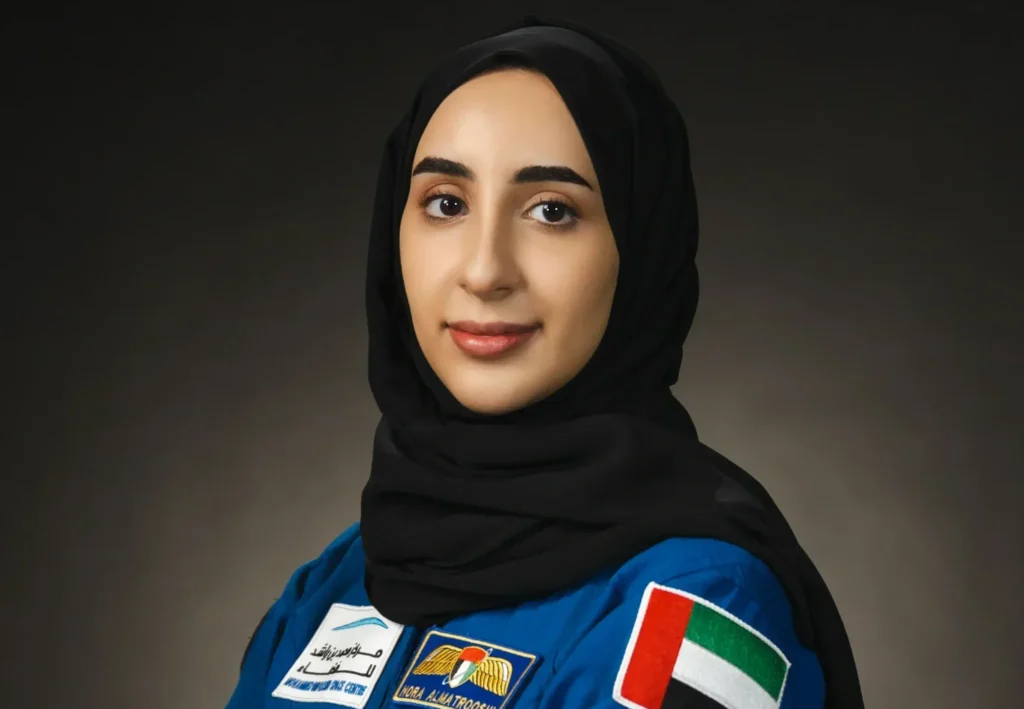
Nora Al Matrooshi, The Star Sailor Rewriting Arab Horizons
Nora Al Matrooshi, The Star Sailor Rewriting Arab Horizons By Editorial Desk For millennia, the night sky over the Arabian Peninsula has been more than a spectacle. It has been a guide, a calendar and a promise. Desert caravans read the constellations to cross shifting sands, while sailors of the Gulf trusted the stars to carry them across open water. Knowledge of the heavens was not abstract science but lived culture, passed down through memory, poetry and survival. In the twenty first century, that ancient relationship with the cosmos has found a new expression in Nora Al Matrooshi, the first Emirati and Arab woman to qualify as an astronaut. Her achievement is not only technological or professional. It is cultural, symbolic and deeply rooted in the long history of Arab navigation and curiosity. Born in 1993 in Sharjah, Al Matrooshi grew up in a society undergoing rapid transformation, balancing inherited tradition with global ambition. From an early age she spoke openly about wanting to go to space, a dream that might have sounded fanciful were it not so closely aligned with her family history. On her mother’s side, she comes from generations of sailors who worked the trade routes of the Arabian Gulf and the Indian Ocean. Their lives depended on reading winds, currents and stars, an intimacy with nature that echoes uncannily in modern spaceflight. The Greek origin of the word astronaut means star sailor, a coincidence that feels almost fated in her case. Where her ancestors crossed water, she is preparing to cross the vacuum. Her path to the astronaut corps was built on discipline rather than romance. She studied mechanical engineering at the United Arab Emirates University, graduating with distinction and establishing herself as one of the strongest students of her cohort. Engineering in the Gulf has long been associated with nation building, from energy infrastructure to urban expansion, and Al Matrooshi entered the workforce at the National Petroleum Construction Company as a piping engineer. There, she contributed to large scale industrial projects while also taking on a leadership role as vice president of the company’s youth council. In that capacity, she advocated for young Emiratis, particularly women, to see technical fields not as intimidating domains but as spaces in which they belonged. Her selection in 2021 for the UAE Astronaut Programme marked a turning point not only in her own life but in the cultural imagination of the region. More than four thousand applicants competed for two places. When Al Matrooshi was announced alongside Mohammad Al Mulla, the message was unmistakable. The national ambition to reach space was not gendered. It was collective. In a region where women’s progress is often discussed through external stereotypes, her selection reframed the narrative from within, presenting competence, resilience and aspiration as shared values. Training as an astronaut required her to adapt to one of the most demanding professional environments in the world. At NASA’s Johnson Space Center in Houston, she undertook years of instruction in spacecraft systems, robotics, geology, survival training and high performance aviation. She flew the T 38 jet, trained underwater for spacewalk simulations and learned to operate within the complex ecosystem of the International Space Station. Yet alongside the physical and intellectual challenges came a quieter but no less significant question of identity. How does a Muslim woman maintain her cultural and religious practices within systems designed without her in mind. One widely discussed example was the integration of modest dress with astronaut equipment. Rather than framing this as an obstacle, Al Matrooshi approached it as a design challenge, working with engineers to ensure safety and functionality while respecting her beliefs. The outcome was not a compromise but a demonstration that inclusion in science does not require erasure of identity. It showed that modern exploration can expand not only our physical reach but also our understanding of who gets to participate. The image of Al Matrooshi in a flight suit has resonated far beyond aerospace circles. For many in the Arab world, she represents a visible shift in what leadership and excellence look like. She speaks frequently about invisible barriers, not always imposed by law or policy but by expectation. By occupying a role historically dominated by men from a narrow set of cultures, she challenges those expectations simply by existing within the system and excelling at its highest standards. Her journey is inseparable from the broader trajectory of the United Arab Emirates, a nation that has placed space exploration at the heart of its long term vision. From the Mars Hope Probe to lunar ambitions, the UAE has framed space not as spectacle but as investment in knowledge, education and international collaboration. Al Matrooshi embodies this philosophy. She often references the forward looking mindset of Sheikh Zayed bin Sultan Al Nahyan, whose belief in education and imagination laid the groundwork for such achievements. In that sense, her story is not an exception but a continuation of a national ethos that treats ambition as a civic duty. Looking ahead, Al Matrooshi has spoken of her hope to take part in future lunar missions as international programmes expand. Whether her path leads to the International Space Station, the Moon or beyond, the cultural impact of her presence is already secure. An Emirati woman training for deep space missions would have been almost unimaginable a generation ago. Today, it is a lived reality. Beyond the technical milestones, she has emerged as a cultural ambassador, articulating a vision in which faith, gender and science are not in conflict but in conversation. Her message to young people is deceptively simple. Pursue what gives you meaning, even when the path is uncharted. In societies where conformity has often been prized over experimentation, that message carries quiet radicalism. Nora Al Matrooshi stands at a rare intersection of past and future. She carries with her the memory of sailors who trusted the stars and the aspirations of a generation determined to reach them. The Arabian night sky, once a guide for survival,