Dubai World Cup 2026
The Day Racing Becomes a Global Spectacle
By Hafsa Qadeer
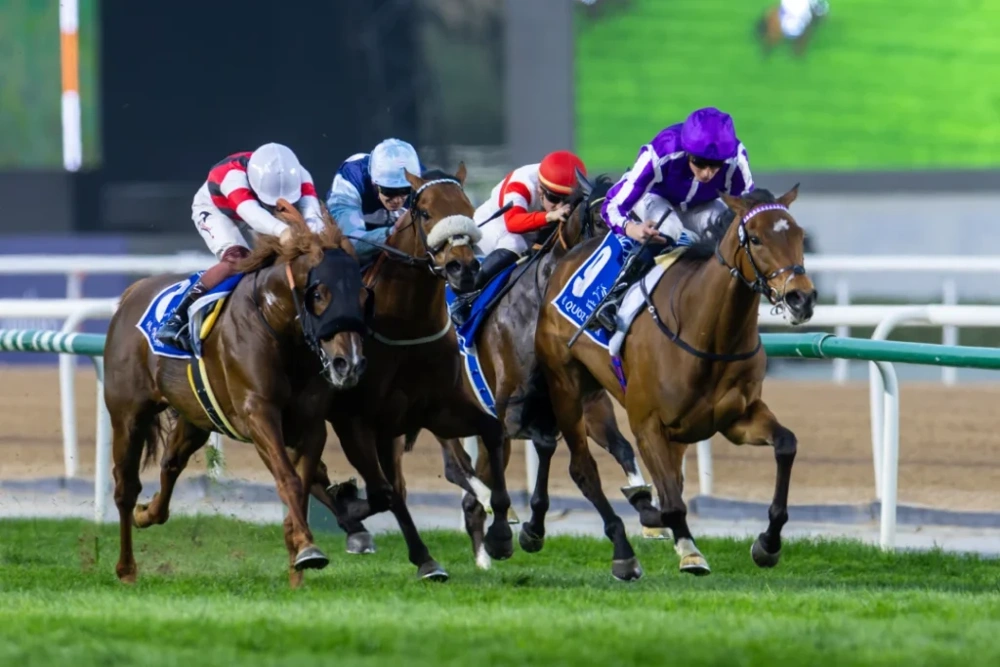
On 28th March 2026, the desert once again transforms into a stage where sport, spectacle, and statecraft converge with calculated precision. The Dubai World Cup returns to Meydan Racecourse, carrying with it not just the weight of expectation, but the certainty of scale. Marketed as the world’s most spectacular race day, it is an event that has, over nearly three decades, grown into something far more deliberate, a global statement shaped through speed, money, and meticulous orchestration.
This year’s edition brings with it a total prize purse of $30.5 million, distributed across nine races that together form one of the richest single-day programs in horse racing. At its centre sits the Dubai World Cup itself, a 2,000-metre dirt race that has consistently drawn elite contenders from the United States, Europe, and Japan. Surrounding it is a carefully curated lineup, including the Dubai Sheema Classic, the Dubai Turf, and the Al Quoz Sprint, each race carrying international prestige and strategic importance within the global racing calendar.
The significance of the Dubai World Cup, however, extends well beyond prize money. Since its founding in 1996 under Mohammed bin Rashid Al Maktoum, the event has been designed as a projection of Dubai’s global ambitions. Meydan itself reflects that intent. With its sweeping grandstand and state-of-the-art facilities, it operates as both venue and symbol, an architectural declaration that horse racing here is inseparable from spectacle.
The promotional imagery for the 2026 edition reinforces this dual identity. Horses surge forward in sharp focus, but the frame is deliberately wider: illuminated skylines, curated luxury, and the promise of a closing ceremony engineered to break multiple Guinness World Records. These finales, now synonymous with the Dubai World Cup, have evolved into productions of extraordinary scale, combining fireworks, synchronized lighting, and aerial displays to create a visual narrative that extends beyond the racetrack and into the city itself.
Yet beneath the surface, the event plays a more strategic role in reshaping global horse racing. Its timing early in the calendar, positions it as a crucial meeting point for international contenders. American dirt specialists, European turf champions, and Japanese runners, often operating within separate circuits, converge here, turning race day into a rare intersection of styles, strategies, and breeding philosophies. For owners and trainers, success at Meydan is not merely a victory; it is a declaration of global relevance.
Economically, the impact is equally deliberate. The Dubai World Cup functions as a magnet for high-net-worth individuals, industry leaders, and international media. Hospitality packages, premium dining experiences, and exclusive viewing suites transform the grandstand into a social arena where business, leisure, and sport intersect seamlessly. The event’s dress culture, an interplay of tradition and contemporary luxury, adds another layer to its identity, reinforcing its position as both a sporting fixture and a social calendar highlight.
Behind this polished façade lies an intricate logistical operation. Horses are transported across continents under strict conditions, adapting to climate, surface, and time zone shifts. Trainers recalibrate strategies for Meydan’s dirt and turf tracks, while jockeys adjust to nuances that can determine outcomes measured in fractions of a second. It is a global effort condensed into a single day, where preparation meets unpredictability.
What distinguishes the Dubai World Cup is its refusal to separate competition from experience. Entertainment is not an afterthought but a central pillar. Live performances, immersive visuals, and the much-anticipated closing ceremony ensure that the event resonates far beyond racing audiences. It speaks to a broader understanding of modern sportcone that recognizes spectacle as integral to engagement.
And yet, when the gates open on 28th March, the narrative narrows. The noise recedes, the spectacle pauses, and what remains is the raw clarity of competition. Hooves strike the track, momentum builds, and for a few fleeting minutes, the essence of horse racing takes over, pure, unscripted, and indifferent to everything that surrounds it.
By the time the final race concludes and Meydan’s sky erupts in orchestrated light, the Dubai World Cup will have once again fulfilled its purpose. It will have drawn the world’s attention not just to a race, but to an idea, one where ambition is performed at scale, and where a single day in the desert becomes a global moment.