Future Mobility In Uae 2025, Piloted Flying Taxis And Autonomous Transport Are Transforming Urban Travel
By Marina Ezzat Alfred
The United Arab Emirates has entered a new era of mobility. In this era, flying taxis are taking off from urban vertiports. Autonomous vehicles are navigating city streets with precision. Smart infrastructure is connecting all modes of transport smoothly. While many countries are still testing new mobility technologies, the UAE is putting them into action. This effort is fueled by long-term national plans and a clear vision to change how people travel in modern cities.
The UAE’s focus on future mobility is based on national plans, like Dubai’s Autonomous Transport Strategy. This strategy aims for 25% of all journeys to be self-driven by 2030. The vision includes advanced transportation systems, such as electric vertical take-off and landing aircraft (eVTOLs), autonomous shuttles, AI-powered ride-hailing fleets, and smart mobility networks that are hyper-connected. These efforts go beyond just upgrading technology. They represent a move toward cleaner cities, less traffic, and a more efficient, sustainable urban way of life.
A New Reality for 2025
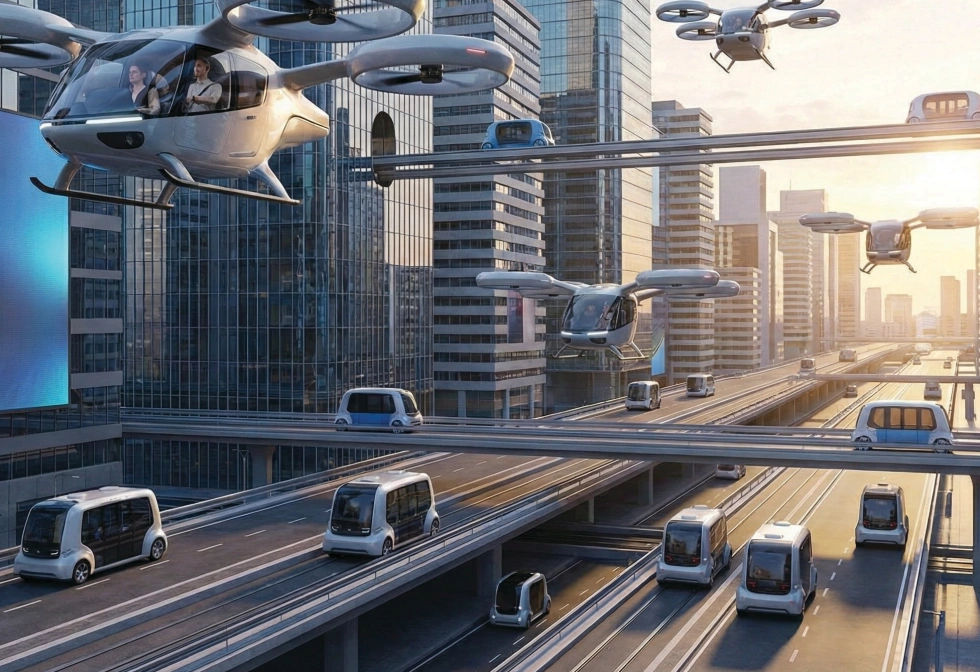
Flying taxis are no longer just a futuristic dream for the UAE; they are beginning official operations on select routes. These aircraft, developed by top companies like Joby Aviation, Volocopter, and EHang, use eVTOL technology to take off and land vertically, making them perfect for crowded city areas. They can carry two to four passengers and travel at speeds between 90 and 180 km/h, allowing people to cross Dubai in just minutes instead of hours.
The rollout has begun with piloted flights, marking an important step before fully autonomous operations become the norm. These piloted journeys give early users confidence, improve overall safety, and help regulators refine long-term policies for urban air mobility. This careful approach shows the UAE’s commitment to responsible, precise, and forward-thinking innovation.
Vertiports and Air Lanes
For flying taxis to be a regular part of daily transport, infrastructure is key. The UAE is already working on it. Dubai’s initial network of vertiports will be located in strategic areas such as Dubai International Airport, Downtown Dubai, Dubai Marina, and Palm Jumeirah. These hubs will connect with existing transportation systems like the metro, electric buses, and autonomous shuttles, allowing for smooth travel across different modes.
Dedicated low-altitude air corridors are also being created to ensure the safe and efficient movement of eVTOL aircraft throughout the city. This complete system, which includes airspace routes, vertiports, charging stations, and digital traffic management, sets Dubai apart as a global leader in urban air mobility.
A Parallel Revolution on the Ground
Alongside flying taxis, the UAE is developing self-driving transport on the ground. Companies like Cruise in Dubai and TXAI in Abu Dhabi are already running pilot fleets of self-driving taxis and shuttles. These vehicles use AI, high-precision sensors, and 5G connectivity to navigate traffic, spot hazards, and make decisions in real time.
The introduction of self-driving buses and last-mile pods completes the travel loop. This makes every stage of travel,from residential neighborhoods to big business areas, efficient and accessible. With centralized monitoring systems and strict safety measures, the UAE ensures that its autonomous networks meet global standards for reliability and user safety.
Benefits for the Economy and Environment
The move towards flying taxis and self-driving transport brings significant benefits. For the environment, relying less on traditional vehicles leads to lower emissions and reduced noise pollution. For the economy, the mobility sector opens up new chances in aviation technology, software development, maintenance services, and smart city infrastructure.
Tourism will benefit as well. A flying taxi ride over the Dubai skyline is expected to become a high-end travel experience that enhances the UAE’s global reputation for luxury and innovation.
Challenges and the Road Ahead
Despite its rapid progress, future mobility in the UAE faces natural and technological challenges. Heat, sandstorms, and visibility issues require strong aircraft designs and improved navigation systems. Expanding the network also needs ongoing investment in charging solutions, vertiport growth, and updates to regulations.
Still, the path forward is clear. After the 2025 piloted phase, the UAE plans to gradually shift toward fully autonomous flying taxis, highly integrated mobility apps, and possibly even inter-city hyperloop systems.
With its bold vision, new technology, and hands-on governance, the UAE is changing what the world expects from urban mobility. The 2025 launch of piloted flying taxis and the growth of self-driving transport are just the start of a bigger change. This positions the UAE not only as a user of future mobility but as a country that is actively shaping the future.