
The New Silk Road, Weaving Digital Heritage into Gulf Luxury
By Marina Ezzat Alfred
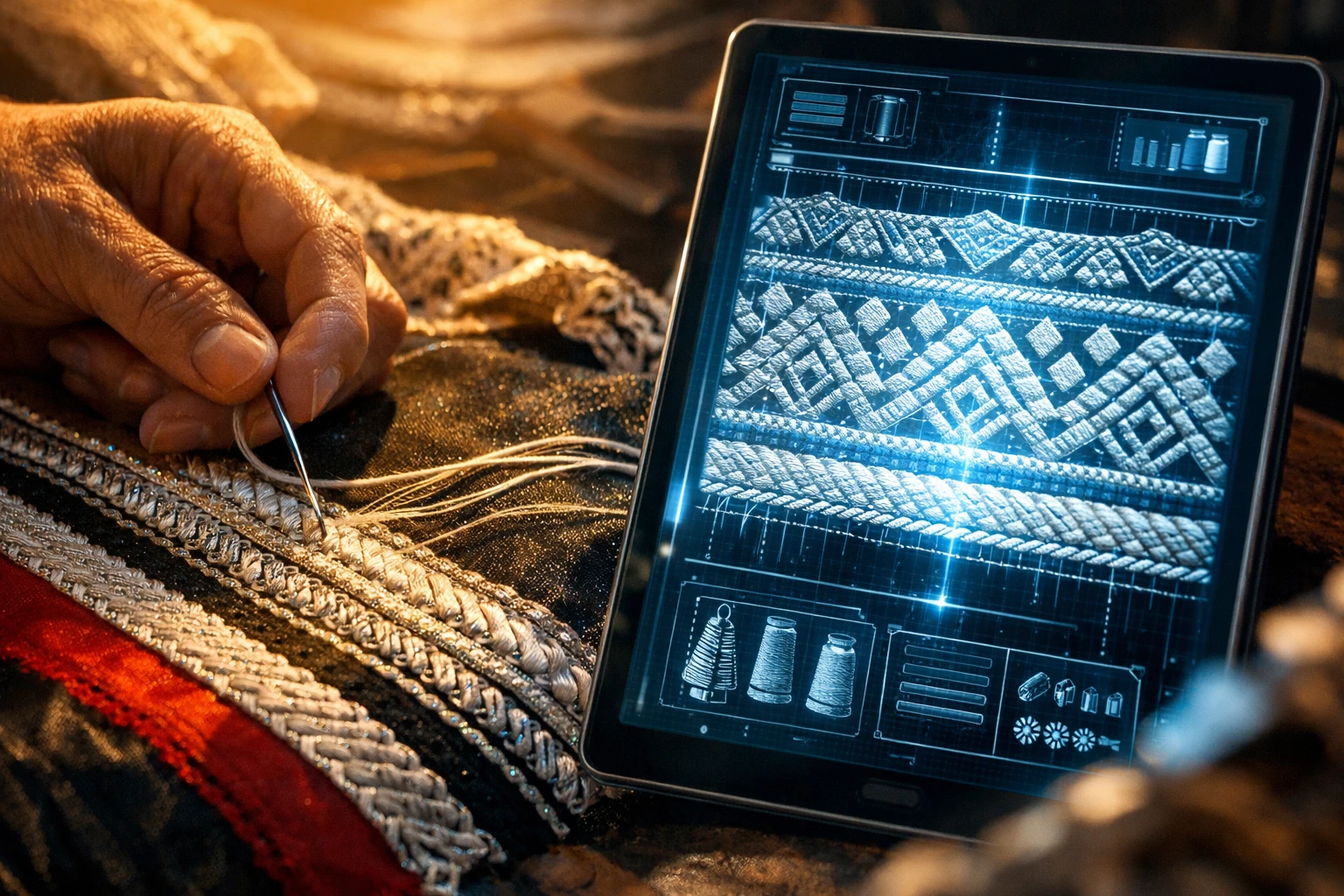
At dawn, in a small workshop where sunlight slips through wooden shutters, a woman runs her fingers across a length of fabric her grandmother once embroidered by hand. The stitches tell stories, of long evenings, whispered prayers, and a patience learned from the desert itself. Today, beside her, a screen glows softly. It studies those same stitches, memorizing their rhythm, their imperfections, their quiet beauty. This is the new Silk Road: not a path of caravans, but a meeting point where memory and machine sit side by side, each honoring the other.
Craft-Tech was born in moments like this. Not as a rebellion against tradition, but as an act of devotion to it. Technology here does not replace the human hand; it protects it from time, from loss, from being forgotten in a fast-moving world.
Every algorithm becomes an archive, every digital pattern a promise that the soul of Arab craftsmanship will continue to travel forward, stitched into fabrics made for the Gulf sun, carried by a generation that wears its heritage with intention and pride.
Craft-Tech When Code Learns to Respect the Hand
In the ateliers of the Gulf, artificial intelligence moves quietly, almost reverently. It is not invited in as a shortcut, but as a guardian. Designers offer it thousands of hours of human devotion: archival Talli patterns, the precise pull of Zari threads, the gentle geometry passed from mother to daughter across generations. The ambition is never speed. It is fidelity to the hand, the heritage, and the meaning behind every stitch.
One Emirati designer describes the process as “teaching a machine to listen before it speaks.” The technology studies how stitches breathe in the heat, how threads respond to movement, how nomadic life once shaped every motif. What emerges is not a replacement for craftsmanship, but its preservation, a living digital memory that can replicate with extraordinary accuracy, while still relying on human hands to give it soul. In this way, Craft-Tech becomes cultural conservation, protecting what might otherwise be lost to time and mass production.
Interview Voices Designers as Cultural Stewards
Across the region, designers no longer speak like trend forecasters chasing what’s next, but like historians protecting what must endure. In Saudi Arabia, one couturier describes how her studio uses AI to trace the life of a single stitch across decades, how it shifted with migration, softened with climate, and adapted to the rituals of daily life. “The machine doesn’t erase the past,” she says quietly. “It reveals it.”

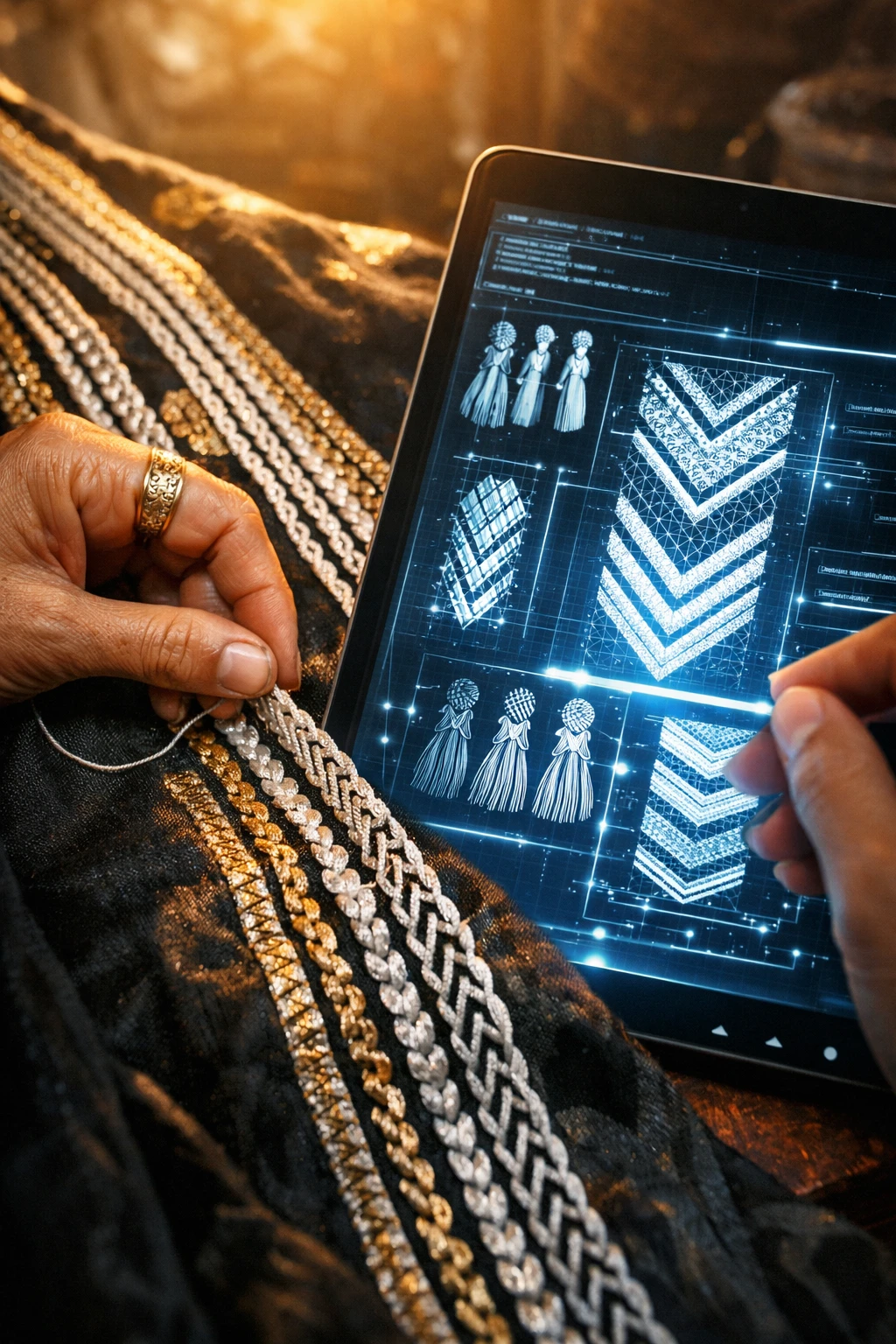
In Bahrain, another designer uses generative tools to test how ancestral embroidery lives on eco-engineered fabrics made for extreme heat. She smiles as she explains, “Our grandmothers worked with what they had. We do the same, but our tools are different.” What binds these voices is a shared belief that technology should extend memory, not overwrite it, becoming a lens that clarifies heritage, rather than a force that turns it into something disposable.
Sustainable Luxury for a Desert Reality
Luxury in the Gulf has never been indulgence for its own sake. Beneath the shimmer and scale, it has always answered the desert, through flowing silhouettes that move with the wind, breathable textiles that respect the sun, and layers designed for life in shifting heat. Today’s innovation does not break from this wisdom; it continues it, quietly and intelligently.
Craft-Tech embroidery now lives on climate-conscious fabrics shaped for this reality: plant-based silks, recycled metallic threads, and textiles engineered to reflect heat while allowing the body to breathe. AI helps designers anticipate how ancestral stitches will respond to modern environmental stress, reducing waste and unnecessary experimentation. This is sustainability born of place, not trend. Conscious couture in the Gulf is not borrowed philosophy, it is ancestral logic, refined for the future.
Fashion as Storytelling
Along this new Silk Road, garments are no longer created simply to be admired, they are meant to be read. Each piece carries a story close to the body: a hand-embroidered panel whispering of coastal pearl divers and salt-stung mornings, a digitally preserved motif echoing the geometry of Bedouin tents beneath open skies.
Through Craft-Tech, designers weave these layers of memory into fabric, allowing the story to travel the world without ever losing its accent. Global audiences are responding not only to beauty, but to meaning. Conscious couture offers a quiet transparency, revealing where the craft was born, who shaped it, and how it honors both people and planet. In this space, luxury slows down. It becomes deeper, more personal, and profoundly intimate, like a story told softly and meant only for those willing to listen.
The Global Future Rooted in Sand
As Gulf fashion steps onto the world stage, it does so without leaving itself behind. The embrace of AI and advanced technology is not a race to imitate Western production models, but a deliberate choice to offer something different, an approach where innovation lowers its head to heritage, and progress moves at the pace of respect.
This new Silk Road is not built on volume, but on value. It proves that the soul of Arab craftsmanship can exist within a digital file, breathe through sustainable fabric, and still feel unmistakably human against the skin. In the soft hum of machines learning ancient stitches, the desert finds its voice once more, speaking quietly, confidently, to a global audience finally ready to listen.