Inside Dubai World Cup,
Where Horses and High Society Collide, Gorgeous Glory in the Desert
By Marina Ezzat Alfred
A woman steadies the brim of her hat as the wind shifts across the grandstand, the fabric catching light for a brief second before settling back into place. Around her, cameras flicker in small bursts, conversations pause and resume, and somewhere below, almost unnoticed beneath the choreography of appearance, a horse exhales, sharp, controlled, ready. At Meydan Racecourse, these moments do not compete with each other. They unfold in parallel, part of the same carefully constructed reality.
The Dubai World Cup 2026 does not begin with the opening of gates. It begins hours earlier, in the slow accumulation of presence. Guests arrive not simply to watch but to participate, moving through an environment that has been designed as much for perception as for performance. By the time the floodlights settle into their full intensity, the desert has already surrendered its heat, leaving behind a cool, controlled atmosphere where anticipation sharpens rather than disperses. More than sixty thousand people occupy the space, yet it rarely feels like a crowd. It feels arranged.
The scale is easy to recite and, perhaps for that reason, easy to overlook. A total purse of $30.5 million across nine races. Twelve million assigned to the feature event alone. Over one hundred horses, flown in from more than a dozen racing nations, each representing an entire ecosystem of breeding decisions, financial risk, and long-term strategy. But numbers here behave like architecture; they hold everything together without demanding attention. What defines the night is something less tangible: the alignment of speed, spectacle, and identity into a single, uninterrupted experience.
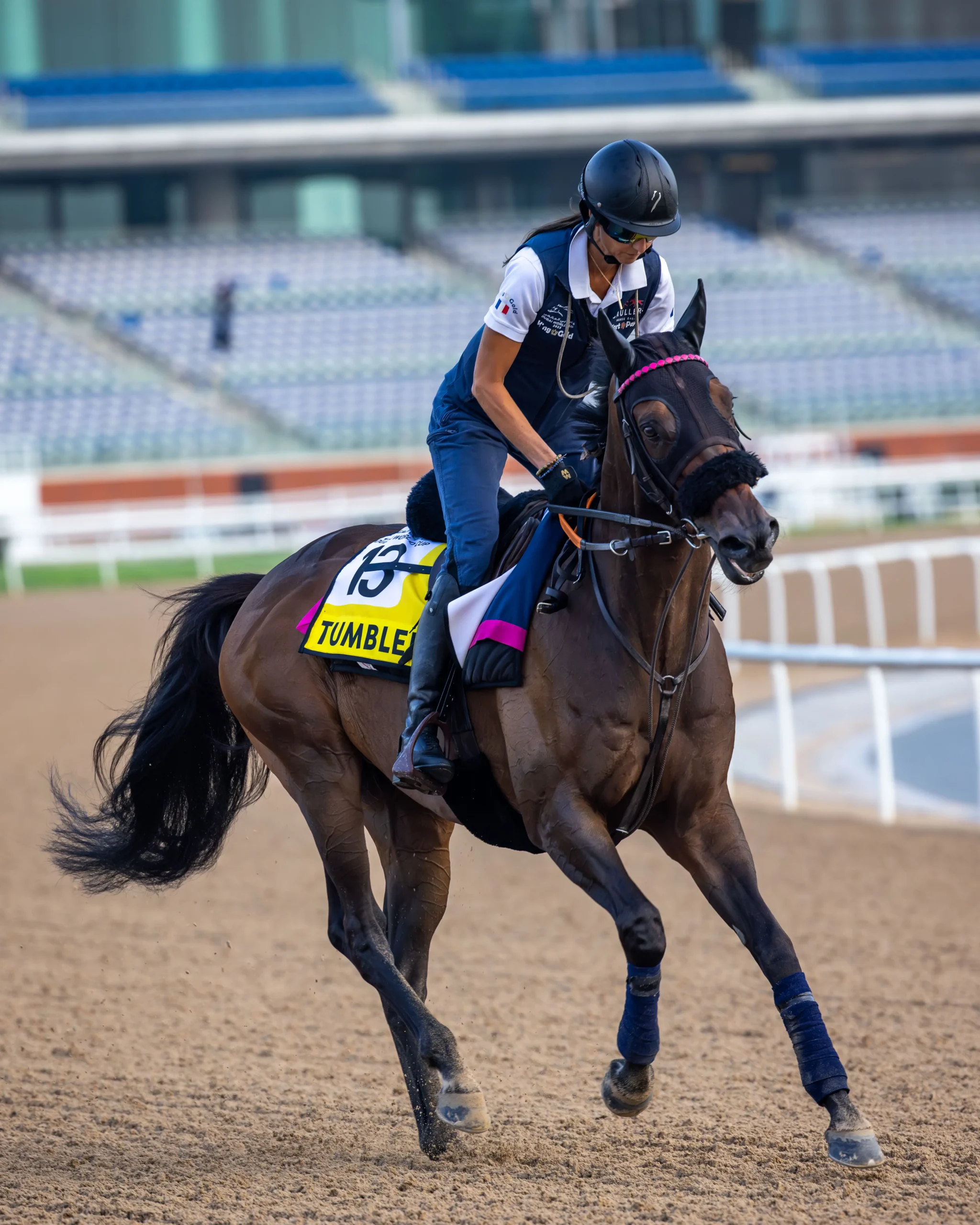
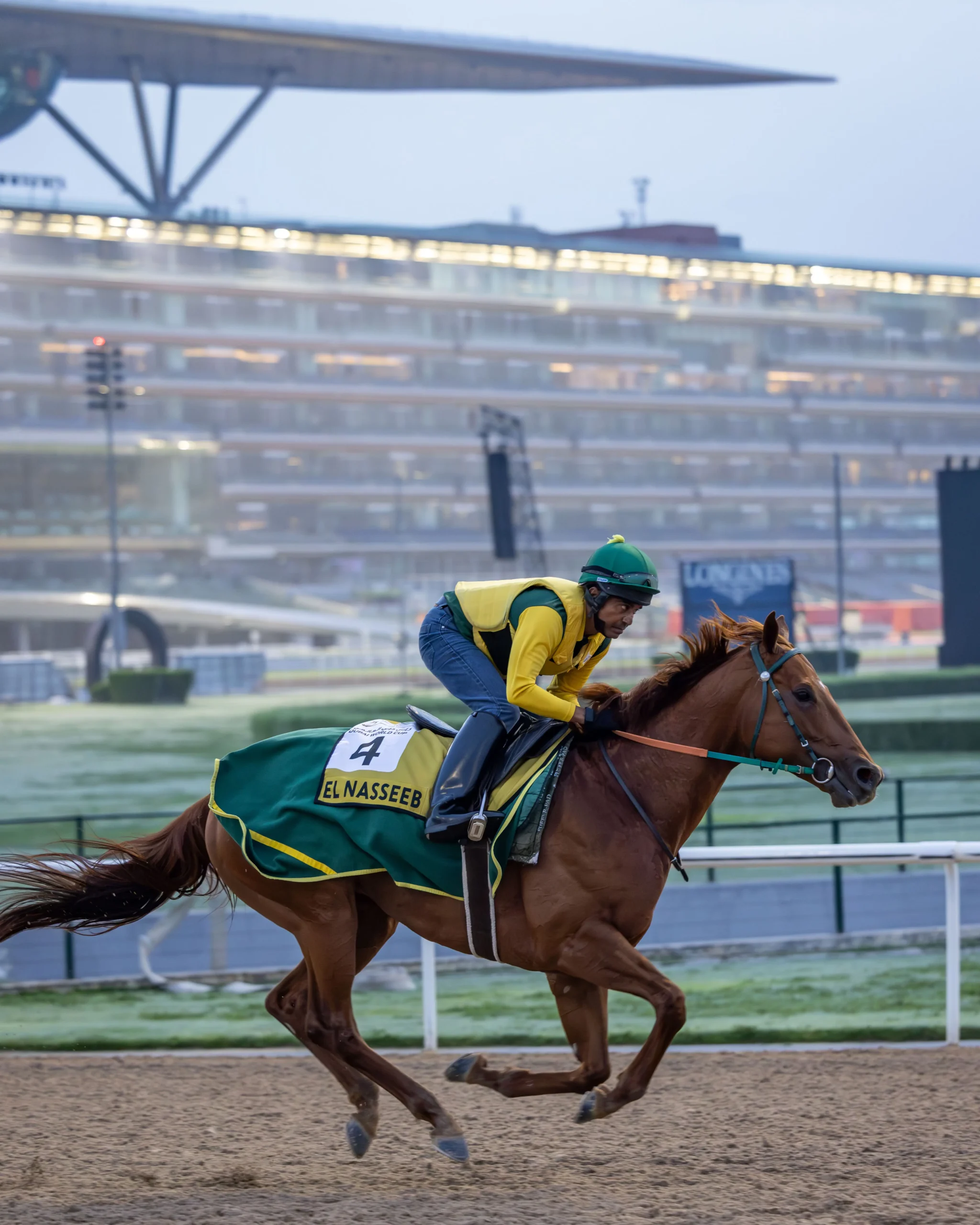
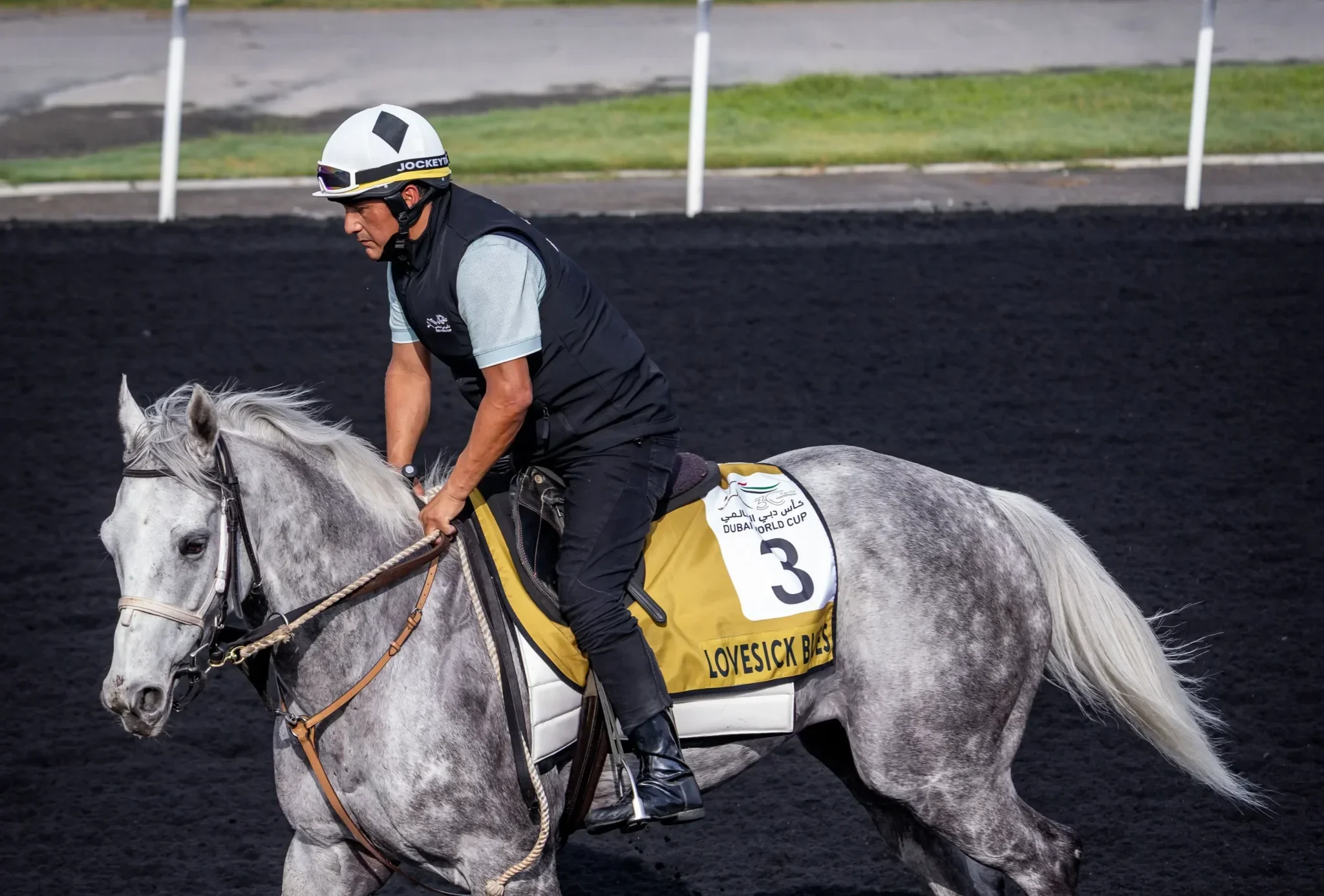
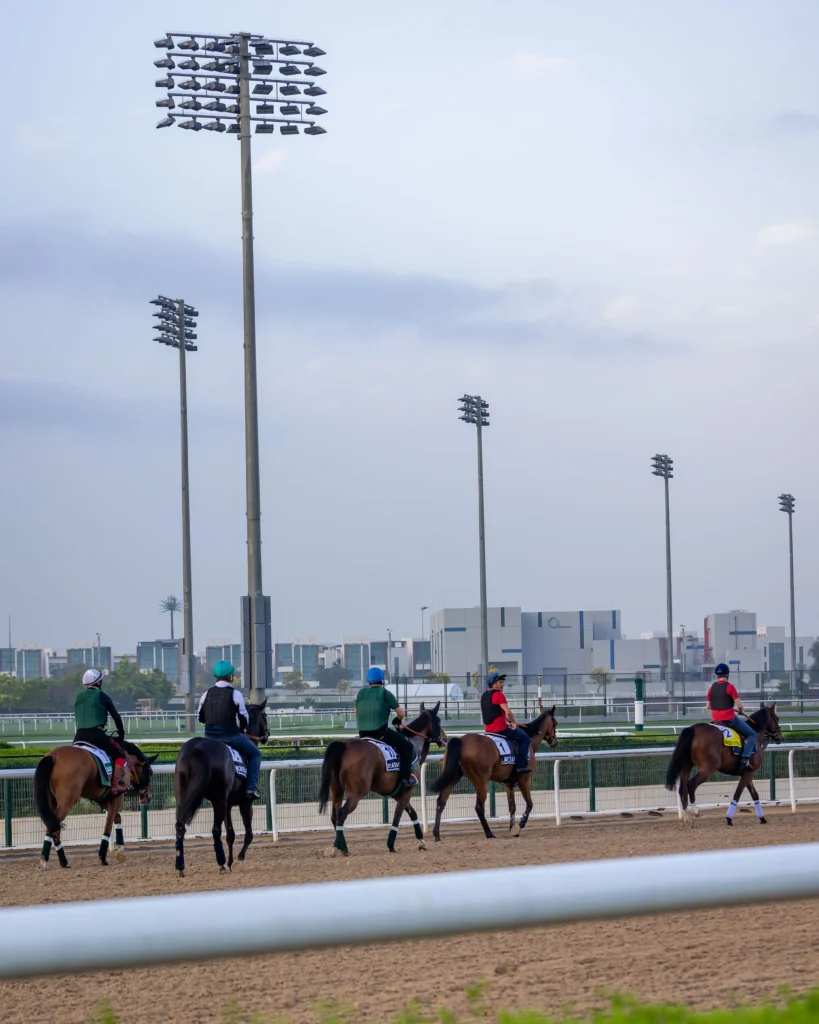
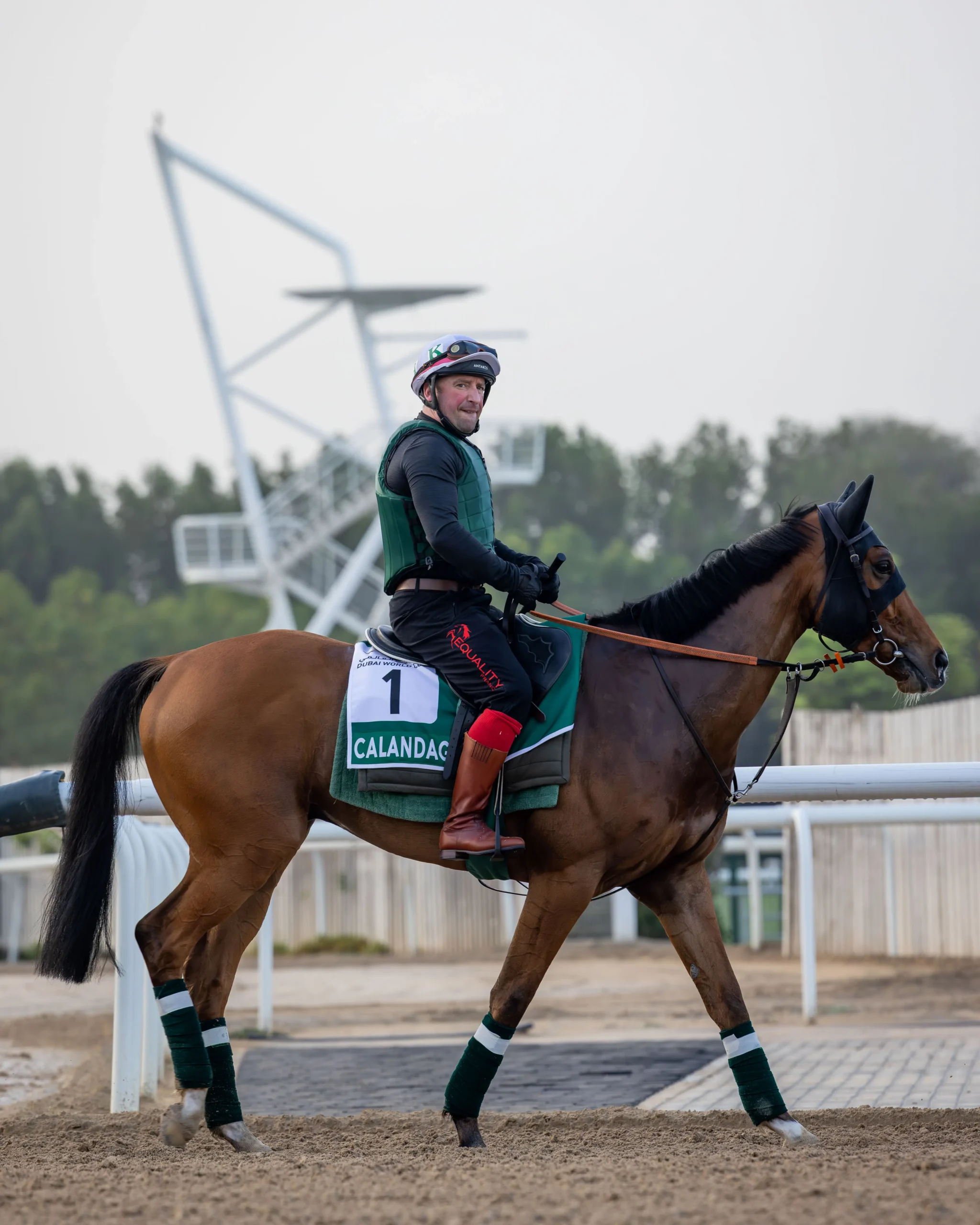
There is a moment, just before the races begin, when the track exists in a kind of suspended calm. Handlers move with practiced efficiency, their gestures economical, almost invisible unless watched closely. The horses, by contrast, carry a contained energy that resists stillness. Muscles shift beneath polished coats, hooves strike lightly against the ground, and the air feels charged in a way that has little to do with the crowd above. It is here, away from the spectacle, that the event reveals its most honest layer, before performance, before presentation, before narrative takes hold.
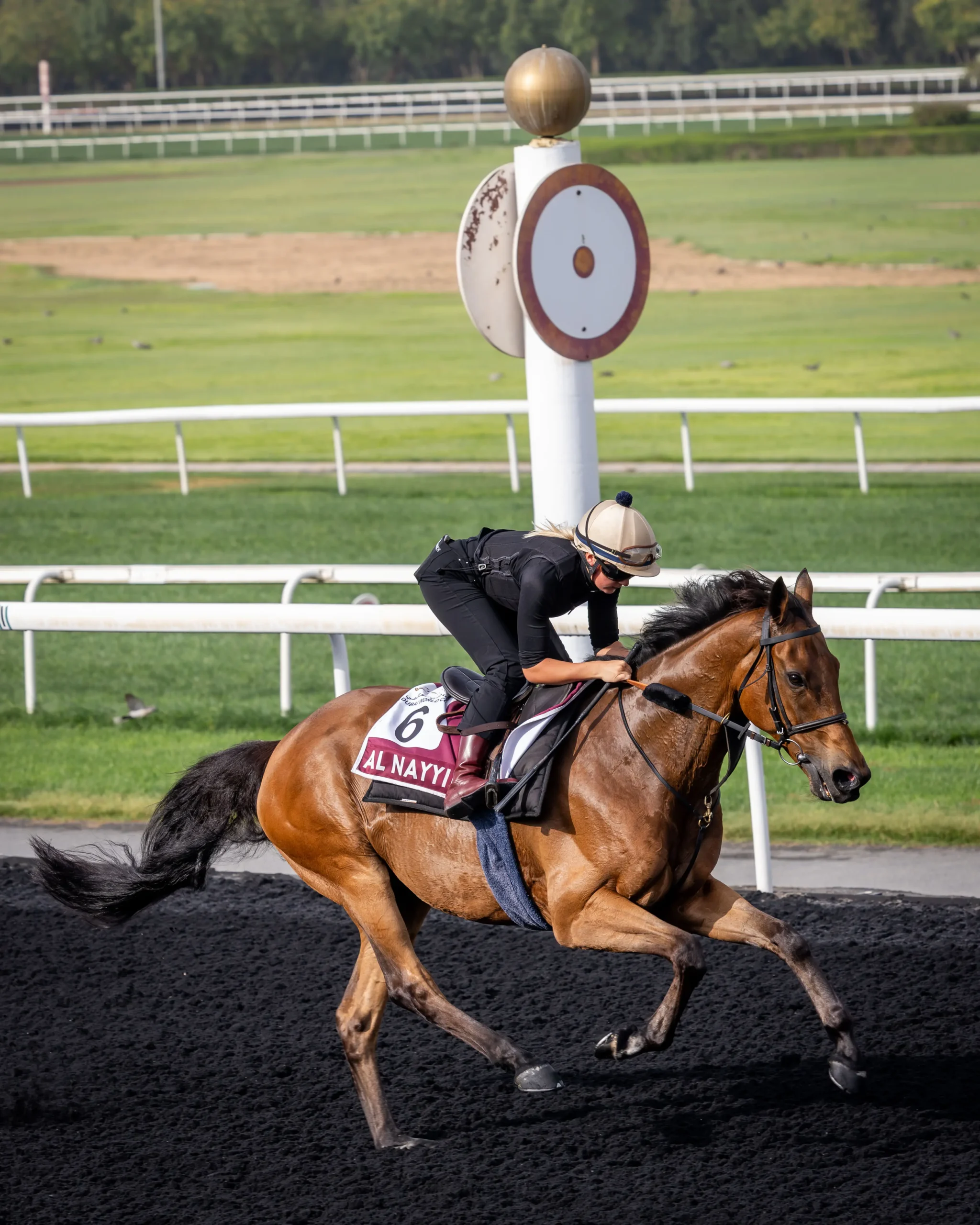
When the gates finally open, the effect is immediate and absolute. Everything that existed before, the fashion, the conversation, the layered performances of presence, recedes into the background. Magnitude breaks cleanly, not with urgency but with control. There is a rhythm to the early stages of the race, a measured precision that feels almost rehearsed. Ridden by Jose Ortiz and trained by Steven Asmussen, Magnitude does not rush to dominate. He holds a position, responding rather than initiating, as if aware that this race will not be decided in its opening moments.
Ahead, Forever Young carries a different kind of weight. Entering as one of the strongest contenders, the horse represents more than individual form; it reflects the steady rise of Japan’s presence in elite dirt racing, a system that has been refining itself quietly, consistently, for years. For much of the race, expectation and execution appear aligned. Then, in the final stretch, the margin between certainty and outcome begins to dissolve.
What follows is not dramatic in the way spectacle often demands. There is no exaggerated shift, no singular moment that announces itself as decisive. Instead, it unfolds through fractions, a slight adjustment in pace, a narrowing of space, a response measured in instinct rather than instruction. Magnitude advances. The distance closes. The balance shifts almost imperceptibly until it can no longer be ignored. By the time the finish line arrives, the result feels both inevitable and unexpected, the clock recording 2:04.38 over two thousand metres, a time precise enough to define the outcome but insufficient to fully explain it.
And then, just as quickly, the race releases its hold. Sound returns in layers, the rise of voices, the delayed reaction of those who were watching something else entirely, the quiet recalibration of a space that had, for a few seconds, been unified by attention. It is here that the Dubai World Cup reveals its dual nature. For some, those seconds are everything. For others, they are part of a much larger narrative that extends far beyond the track.
In the grandstand, the performance resumes, though it never truly paused. The Style Stakes competition continues to draw its own audience, transforming personal style into a parallel form of competition. Tailoring, color, proportion, each element is considered with a precision that mirrors the calculations taking place on the track below. A man adjusts his cufflinks, glancing briefly at the results before returning to a conversation that has nothing to do with racing. Nearby, a woman studies the silhouettes moving through the crowd, her attention fixed not on the outcome of the race but on the composition of the moment.
Neither perspective diminishes the other. This coexistence is not incidental; it is the defining characteristic of the event. The Dubai World Cup has never insisted on a singular identity. Instead, it operates through layering, allowing sport, fashion, business, and social presence to occupy the same space without hierarchy. What might feel like a distraction elsewhere becomes, here, part of the design.
This design extends beyond the visible. Since its beginnings in 1996 at Nad Al Sheba Racecourse, the World Cup has evolved alongside the city itself, growing in scale and complexity as Dubai refined its position on the global stage.
The move to Meydan was not simply logistical; it was declarative. The architecture, with its sweeping lines and controlled visibility, does more than house an event; it shapes how that event is experienced. Movement is guided. Perspective is framed. Even light is used with intention, transforming the racecourse into something that feels, at times, suspended from its surroundings.
To describe this as a spectacle would be accurate, but incomplete. Spectacle suggests excess, a kind of unrestrained display. What exists at Meydan is closer to precision. Every element, hospitality, presentation, and timing operate within a system that prioritizes coherence. The result is an environment where nothing feels accidental, even when it appears effortless.
Beyond the grandstand, the city itself absorbs the rhythm of the event. Hotels operate at near capacity, their lobbies filled with a transient mix of languages and intentions. Chauffeured cars move in steady circulation, connecting the airport, hotel, and racecourse in a loop that feels both temporary and recurring. Restaurants extend their hours, retail spaces sharpen their displays, and the broader economy adjusts, subtly but decisively, to accommodate the influx. The World Cup does not exist in isolation; it radiates outward, shaping the city’s tempo in ways that are both visible and discreet.
Yet beneath this surface, there are quieter dynamics at work. For those within the racing industry, the Dubai World Cup is not simply an event but a strategic anchor. The prize money alone reshapes decisions made months, even years, in advance.
A twelve-million-dollar feature race influences breeding choices in Kentucky, training schedules in Ireland, and campaign strategies in Japan. Participation is not only about winning; it is about visibility, about positioning within a global hierarchy that extends far beyond a single night.
Each horse that arrives carries this weight. It represents a lineage, a sequence of decisions stretching across generations. Horse racing remains one of the few sports where time operates in this way, where the past is not background but an active presence. When a horse runs at Meydan, it brings with it the accumulated logic of breeding farms, training yards, and financial calculations that rarely become visible to the audience. For a brief moment, all of that complexity condenses into motion.
The 2026 edition carried an additional layer of meaning, shaped not by the event itself but by the world around it. In a period marked by shifting geopolitical tensions and uneven global attention, the decision to proceed at full scale felt less like defiance and more like continuity. The races ran. The stands are filled. The system held. There is a particular kind of confidence in repetition, the quiet assertion that certain rhythms will continue, regardless of external uncertainty. For Dubai, this consistency has become part of the World Cup’s identity, reinforcing its role not just as a sporting fixture but as a signal.
And yet, even within this consistency, questions remain. Who is the event truly for? The purist, focused entirely on the integrity of the race, might argue that everything beyond the track risks dilution. The social attendee, moving through spaces of fashion and conversation, might see the race as only one component of a broader experience. What is striking is not the existence of these perspectives, but their coexistence. Dubai does not resolve the tension between them; it accommodates it, allowing multiple narratives to unfold simultaneously.
There is also a quieter, less visible audience, the global viewer, watching through screens, encountering the event not as a physical experience but as a curated image. For them, the Dubai World Cup exists as a sequence of impressions: the brightness of the lights, the elegance of the crowd, the velocity of the race. What is lost in translation is scale, the subtle shifts in atmosphere, the moments of stillness between spectacle. And yet, even in this mediated form, the event retains its pull, suggesting that its power lies not only in presence but in perception.
As the night progresses, the intensity begins to shift. The earlier urgency softens into something more reflective. Conversations lengthen. Movements slow. The track, so central just hours before, recedes slightly, becoming part of a larger memory rather than its defining feature. But one moment persists with clarity: Magnitude’s final surge, the subtle shift that transformed possibility into outcome, the brief alignment of attention that cut through every other layer of the event.
When the floodlights eventually dim over Meydan Racecourse, what remains is not simply the result recorded in time and position. It is the accumulation of detail, the precision of organization, the layering of experience, the merging of worlds that rarely intersect but, here, feel entirely coherent. The Dubai World Cup continues to occupy a rare space in modern sport, not because it is the richest or the most elaborate, but because it understands something more fragile.
Attention, once gathered, is difficult to sustain. And in an era where it is constantly divided, to hold it, even briefly, even imperfectly, is a form of power that extends far beyond the finish line.