
Aparna Verma, Leading Education with Substance in an Age of Noise
By Bill Brown

In a region where education has become one of the most competitive and fast-moving sectors, clarity is increasingly hard to find. Parents are surrounded by claims of innovation, future readiness, and global excellence, yet many struggle to understand what truly matters for their child. Against this backdrop, Scholars International Group has taken a different approach, one shaped less by momentum and more by measured thinking, long experience, and a quiet confidence in fundamentals.
For more than fifty years, Scholars International Group has been part of the UAE’s evolving education landscape. During that time, the country has transformed from a place with limited schooling options into a global hub offering a wide range of international curricula. Choice has expanded, information has multiplied, and expectations have risen. Yet, according to Aparna Verma, CEO of Scholars International Group, the essence of parental decision-making has remained remarkably consistent.
Parents, she observes, have always been cautious when choosing a school. The difference today lies in the environment surrounding that choice. Families now navigate constant comparison, heightened competition, and a flood of information that often creates more anxiety than reassurance. In such a climate, schools carry a greater responsibility, not only to educate children, but to offer parents clarity, stability, and trust.
Scholars International Group has responded to this reality by resisting the temptation to follow every new trend. Instead, it has focused on disciplined delivery: strong leadership, high-quality teaching, and consistency across its schools. For Aparna, leadership in education is not about visibility or volume of messaging. It is about sustained quality, delivered quietly and reliably over time.
This philosophy shaped the launch of The Scholars School, SIG’s latest venture. Rather than beginning with assumptions about what families wanted, the group began by listening. A detailed Parent Insight Study was conducted to better understand how parents perceive education today and where they feel uncertain or unheard.
The findings were telling. More than seventy-four percent of parents expressed a desire to be actively involved in their child’s education. Yet involvement did not mean control. Parents wanted understanding, reassurance, and visibility, not daily management of classroom decisions. Perhaps most importantly, they wanted to feel heard before being spoken to.
This insight fundamentally shaped how SIG communicates with families. Instead of increasing the frequency of messaging, the group focused on structure and clarity. Clear routines, predictable rhythms of communication, and professional, open dialogue between teachers and parents became central. The aim was to build genuine partnerships, relationships in which parents feel confident and informed, and teachers feel trusted and supported.
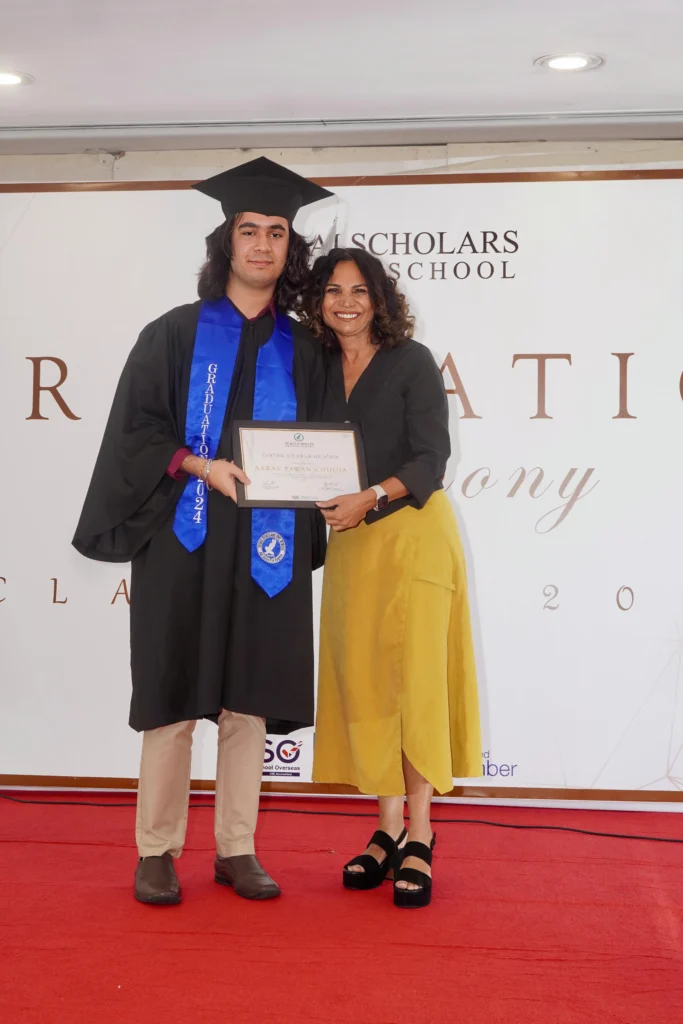
For Aparna, this balance is critical. Education works best when parents and teachers share responsibility without blurring roles. Trust grows when families understand how learning is delivered and why decisions are made, while teachers are given the space to apply their professional expertise.
Consistency, in fact, has emerged as one of the most important markers of quality in the eyes of parents. Research conducted by SIG shows that families judge schools not only on academic outcomes, but on leadership stability and visible teaching quality. In response, Scholars International Group has built shared academic foundations across its schools, with common frameworks, clear expectations, and aligned teaching practices.
The Scholars School is not treated as an isolated project. It is an extension of systems refined over decades. Professional development, academic oversight, and leadership presence are embedded across the group. These structures are not hidden; they are visible and accessible, allowing parents to see how quality is sustained in daily practice.
Innovation, in this context, is approached carefully. In an era where educational trends emerge quickly and disappear just as fast, SIG has chosen to be guided by evidence rather than fashion. Parents, according to the group’s research, consistently express a preference for strong fundamentals over experimental approaches. This has shaped the way innovation is introduced, not as a headline, but as a tool to deepen learning.
The Scholars School follows a British curriculum, internationally recognised for its rigour and structure. This is enriched by research-based frameworks such as High-Performance Learning and informed by insights from cognitive science. Oversight from an experienced board ensures that research is applied thoughtfully, always with a clear link to student learning.
At the centre of this approach are teachers. Aparna is clear that student outcomes and teacher development are inseparable. Parents may speak about results, but what they are really observing is teaching quality and consistency. For this reason, Scholars International Group invests heavily in ongoing professional development aligned with its shared pedagogy.
Training is continuous and purposeful, directly connected to classroom practice. Teachers are supported not only to deliver content, but to grow within a shared vision of education. This support, Aparna notes, has a ripple effect. When teachers feel valued and confident, school culture strengthens, motivation rises, and students benefit.
Equally important is the way SIG approaches student wellbeing. Academic rigour and emotional safety are not treated as competing priorities. Research conducted by the group shows that parents value structure, predictability, and emotional security, particularly in the early years. These elements create environments in which learning can thrive without anxiety.
Classrooms across SIG schools are designed to be calm and structured. Clear routines help children feel secure, build confidence, and develop a sense of belonging. For Aparna, emotional well-being is not an additional programme; it is the foundation that allows academic rigour to be sustained.
Operating in the UAE adds another layer of responsibility. The country’s diversity and forward-thinking vision require schools to create inclusive environments that respect cultural context while preparing students for global citizenship. SIG’s research shows that many parents think deeply about how their children develop identity in a highly international setting.
The Scholars School delivers the British curriculum in a way that reflects the UAE’s social and cultural fabric, enriched by global best practices drawn from across the group. This emphasis on belonging, stability, and family values aligns naturally with the UAE’s Year of the Family initiative. For SIG, this alignment is practical rather than symbolic.
Technology, too, is approached with balance. Parents have expressed concerns about over-reliance on screens and the loss of human connection in learning. SIG agrees. Technology is used to support teaching by reducing administrative workload, tracking progress, and strengthening communication with families. Classrooms remain teacher-led, and in some cases, tech-free days are introduced to encourage balance.
Underlying all of this is trust. In a time when parents are increasingly sceptical of exaggerated claims, SIG has focused on transparency. Clear fee structures, visible leadership, and consistent systems help families understand how decisions are made and how learning is delivered. Trust, Aparna believes, cannot be marketed. It must be earned through daily action.
Looking ahead, SIG’s vision for the next decade is shaped by a widely cited estimate from the World Economic Forum: by 2035, sixty-five percent of today’s primary-aged students are expected to work in roles that do not yet exist. This reality reinforces the need to prepare children not just academically, but as adaptable, confident learners.
At The Scholars School, this means blending rigorous academics with critical thinking, creativity, emotional intelligence, and global awareness. Emerging technologies and real-world problem-solving are introduced thoughtfully, alongside a strong emphasis on wellbeing and identity.
In a sector increasingly driven by momentum, Scholars International Group has chosen substance. Its approach is not loud, but it is deliberate. And in an education landscape filled with noise, that quiet confidence may be its greatest strength.