
MAGNAV Emirates

Janhavi Gusani

Rashed Alfalasi

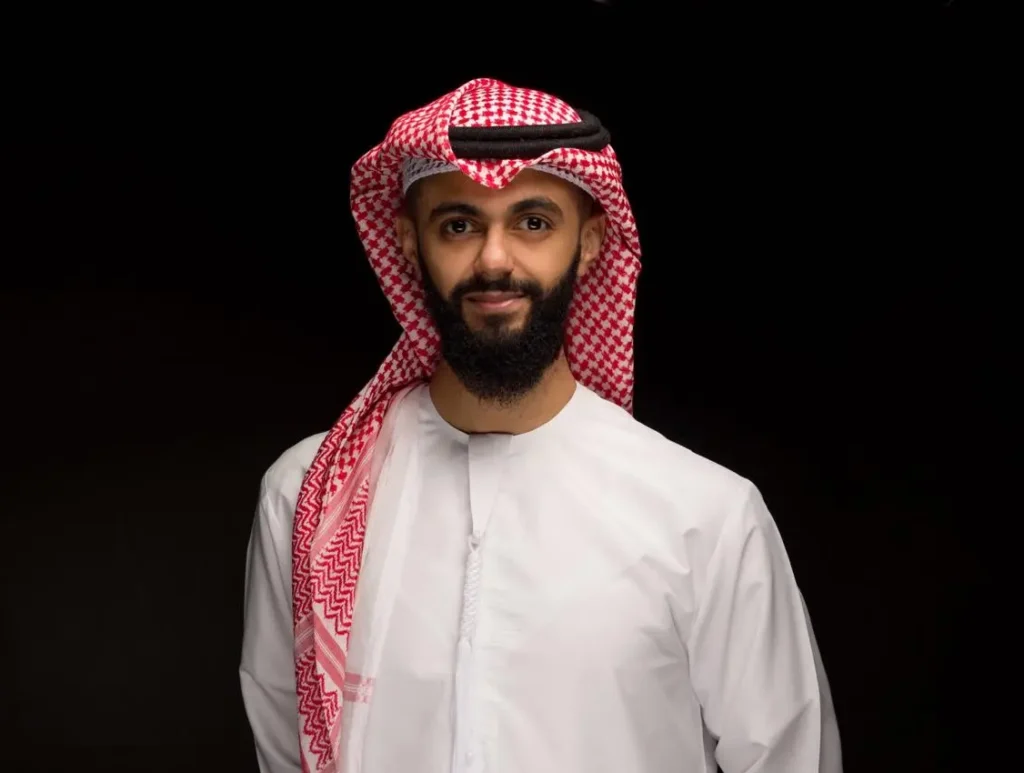
Rashed Alfalasi, The Face of UAE Comedy

Rashed Alfalasi The Face of UAE Comedy and The Voice Behind many creatives Emirati COMEDIAN offers an intimate Conversation with our Readers By Janhavi Gusani Rashed Alfalasi’s journey is anything but conventional. In a world that insists on specialisation, he refuses to be confined to a single identity, moving fluidly between roles as a pilot, comedian, actor, creator, entrepreneur and musician. His life spans skies, stages and screens, yet what defines him most is not the number of titles he holds, but the consistency with which he follows what he loves. His path often surprises people. Trained in business management with a background in graphic design, Rashed entered aviation almost by coincidence, eventually becoming a pilot. Where most careers demand a single edge, he chose a spectrum, guided less by calculation and more by curiosity. Rather than anchoring himself to one destination, he continues to explore across disciplines, allowing each pursuit to inform the other. Comedy, however, was never accidental. What began as a child sharing jokes evolved into a deeper purpose, becoming a voice for those around him. Turning everyday observations into laughter, and laughter into relatability, is an art few master. For Rashed, humour became a bridge, connecting people through shared experiences that are often unspoken yet instantly understood. He does not switch roles, he switches frequencies. One day he is flying at 30,000 feet, the next he is holding a mic, a camera or creating music. Aviation taught him precision and discipline, while creativity offered freedom. Between the two worlds, he learned balance, managing time carefully and gathering ideas quietly. Rashed moves with an observer’s eye, noticing fleeting details and subtle human nuances that later surface as stories. Above all, he believes listening is essential, because connection begins long before the punchline lands. It is a skill that serves him not only as a performer, but also as an entrepreneur and a traveller navigating diverse spaces. Much of Rashed’s inspiration lives in the in between moments others overlook. A short walk from a parking lot to a building, a brief interaction, a passing remark, any of it can spark an idea. Living in the UAE, a country shaped by diversity, has further sharpened his awareness. His humour reflects the multicultural environment he calls home, making relatability universal rather than niche. For Rashed, comedy must be inclusive and sensitive, grounded in shared humanity rather than difference. At the heart of his work lies simplicity and connection, not the need to stand out. Humour only works when people see themselves in it. Relatability is what turns a moment into something meaningful. His aim has never been to perform at an audience, but to speak with them, articulating emotions and experiences many struggle to express, often by finding humour within one’s own reality. Language plays a central role in that connection. Rashed’s seamless movement between Arabic and English became a gateway into comedy, where literal translation exposes cultural nuance and everyday misunderstandings. It was this playful tension between languages that gave rise to his now infamous line, “Who pay?”, a phrase that resonated precisely because it captured a familiar shared experience with effortless clarity. Beyond performance, Rashed views the UAE as more than a tourist destination. He sees it as a growing digital ecosystem that actively nurtures creators. Through initiatives, workshops and career building platforms, the country offers space to experiment and evolve. Yet he believes the greatest barrier is not access, but hesitation. Fear of failure, uncertainty or not being original enough often holds people back. For Rashed, progress begins with the courage to start and the discipline to continue. Over time, consistency shapes a voice of its own, one that naturally sets a creator apart. Success, in his view, is deeply subjective. He describes it as a form of restraint, something that helps define goals, with everything beyond that becoming the end game. For him, success is not a milestone to reach, but an everyday process. Thirteen years into his journey, his greatest achievement lies in practising his craft fully, without expectation of reward. The joy is in the work itself, in showing up daily and allowing growth to unfold organically. Like every personal journey, his has included moments of pause. A period of personal loss led Rashed to step back from social media and take a creative break, sparking rumours, assumptions and half told narratives about his career. Creative paths are rarely linear. Behind every visible moment lies a deeper story, and even absence can test the strength of one’s craft. Returning was not easy. Audiences move on, and some forget. It is a reality every artist eventually faces. What remains, he believes, is the audience that truly belongs, those drawn to connection that lasts beyond trends or algorithms. Rashed understands that life moves in cycles of elevation and restraint. With visibility comes both appreciation and resistance, and engaging with negativity only amplifies it. While encouragement fuels momentum, rumours have a way of pulling one backwards. Restraint, he has learned, is as important as ambition. Even comfort can be deceptive. Familiarity may quietly dull creative instinct. Growth, for Rashed, lies in discernment, knowing what to carry forward, what to leave behind and when to listen inward rather than outward. “Try, no matter what,” he says. “There is nothing to lose. Life is too short to be scared, and regret is part of the journey. It teaches you to grow and make better choices next time.” For him, life is a continuous process of learning, balancing decisions and trusting one’s inner voice. Consistency, positivity, and kindness form the roots of his philosophy. A person of many interests and identities, Rashed remains grounded in the shared humanity that connects us all. His vision is simple, to keep doing what he loves. He resists rigid definitions of success or purpose, believing they can turn creativity into pressure. When driven by joy, effort comes naturally, and whatever emerges from that process becomes its own reward. Perhaps the simplest way to

Eid Al-Itihad Uae National Day

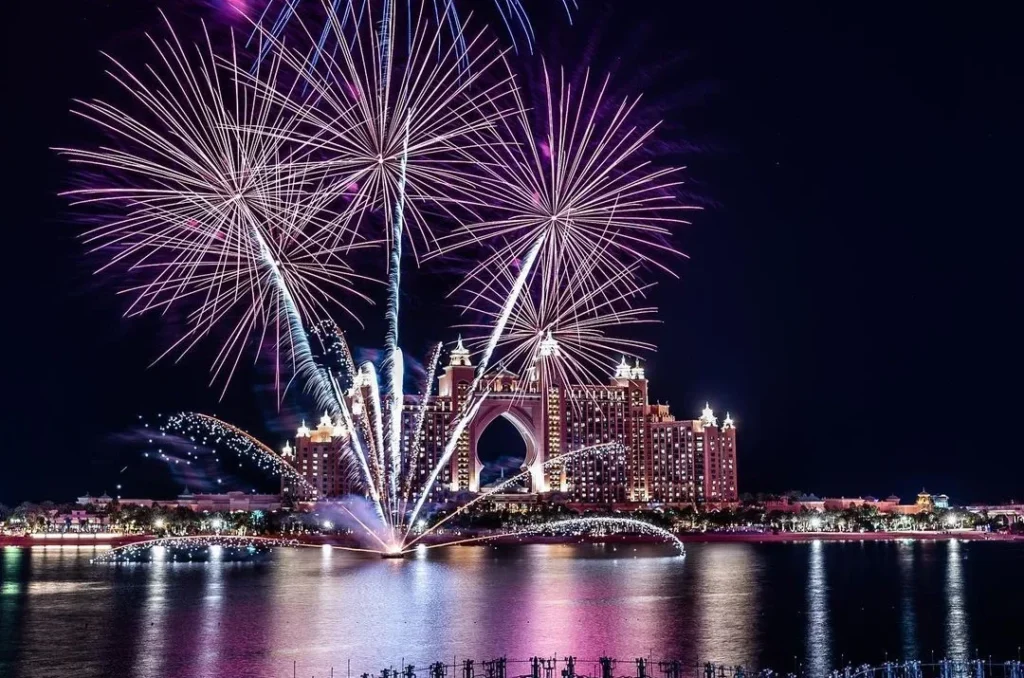
Eid Al-Itihad Uae National Day, Honouring The Past, Uniting The Present, And Imagining A Future Built On Hope & Togetherness

Eid al-Itihad The UAE’s National Day Unity, Culture and A Promise of Prosperity Honouring the past, uniting the present, and imagining a future built on hope and togetherness By Janhavi Gusani Every December 2 the United Arab Emirates pauses to celebrate a story that reads like a modern fable: seven emirates  each with its own history, leadership and traditions choosing union over fragmentation and building, within a single lifetime, one of the most dynamic countries in the world. National Day is both a commemoration and a living manifesto: a ritual that connects the UAE’s foundational values to the ambitions of a future built on tolerance, safety and shared prosperity. As the dawn of 2nd December nears, the nation is wrapped in pride, patriotism, and the vibrant colours of its flag. Eid Al Ittihad is more than a national holiday, it is a commemoration of the UAE’s history, its vision, and its enduring resilience. From the dunes of the Arabian Gulf to the wings of aircraft soaring across the sky, the country prepares to celebrate 54 years of unity this year. A union born of pragmatic idealism The formation of the UAE in 1971 was a practical, visionary response to the needs of a small, disparate region at a moment of rapid change. That strategic choice to bind together for defense, development and dignity remains central to National Day’s meaning. What started as a pragmatic union has been enshrined as a national ethic: collective responsibility, sensible governance and an emphasis on long-term nation-building.  The National celebration starts right from a month ahead as the country celebrates Flag Day on November 3rd. This occasion was established by H.H Sheikh Mohammed bin Rashid Al Maktoum in 2013 as a mark of Sheikh Khalifa bin Zayed al Nahyan’s presidential rise (in 2004) – by quoting it as a “renewed commitment to the values of the UAE, along with a sense of belonging, loyalty and gratitude to the homeland and its leaders” Core values, the moral code behind the momentum At the heart of the UAE’s public narrative are a handful of repeated, powerful values: generosity, tolerance, dignity and service. These are not abstract slogans. The UAE’s founding generation explicitly anchored policy in moral maxims  notably the words of the late Sheikh Zayed bin Sultan Al Nahyan, who urged that “to treat every person, no matter what his creed or race, as a special soul, is a mark of Islam.” Those lines have been translated into institutions and public programmes that prize inclusion and community welfare. Multiculturalism, the city-state effect The UAE’s society is unusually cosmopolitan. Official figures and long-running demographic trends show the country hosts residents from more than 200 nationalities, and expatriates make up the overwhelming majority of residents a fact that shapes everything from festivals to cuisine to the labour market. Rather than flat-line assimilation, the UAE cultivates a model of negotiated multiculturalism: public celebration of diverse cultures alongside civic initiatives that promote workplace equality, religious freedom and cross-cultural exchange. National Day has become an occasion to showcase that mosaic Emirati heritage alongside Indian, Filipino, Egyptian, Pakistani, European and African traditions that are all woven into daily life. Culture and identity, rooted innovation The UAE’s cultural scene during National Day is instructive: traditional arts (poetry, falconry, pearl-diving stories, majlis gatherings) are deliberately staged alongside contemporary music, large-scale public art, and avant-garde design. This duality — rooted tradition plus bold innovation is intentionally cultivated by national cultural strategies and festivals. It frames the UAE not as a place that abandoned the past for the future, but as one that uses its past as a platform for creative reinvention. Prosperity with an eye to sustainability Economic success has been central to the UAE’s post-1971 story. The government’s national strategies from Vision 2021 to “We the UAE 2031” and the Centennial 2071 roadmap explicitly link prosperity to diversification, talent attraction, and high-value knowledge sectors. The message of National Day is therefore both celebratory and aspirational: to honor what has been built, and to articulate the economic targets that will define the next decades. These policy goals double GDP, stronger innovation ecosystems, and a global-talent magnet shape the public conversation around wealth, opportunity and inclusion. Safety and trust,  an asset for everyday life Public safety and order are often taken for granted by residents and visitors alike, but they are a deliberate pillar of statecraft. Recent international indices show notable improvements in the UAE’s peacefulness and safety scores in the past few years, reflecting investments in policing, diplomacy and crisis preparedness. Safe streets, predictable services and stable institutions are part of what makes the UAE an attractive place to live, work and invest and that sense of security becomes more palpable during national festivities, when public spaces fill with families and visitors. Love and belonging, how National Day feels on the ground On the ground, National Day’s aesthetic is intimate and exuberant. Flags drape office towers and balconies; children learn national songs in school; food festivals and Emirati hospitality create moments of cross-cultural exchange. The tone is one of affection rather than performative patriotism: a civic love that’s nurtured by visible public goods (healthcare, transport, public parks) and the rituals that connect people to the state and to one another. A day that builds the year National Day is not merely a public holiday. It is a calibrated civic ritual that performs the UAE’s identity back to itself: a blend of unity and plurality, heritage and invention, stability and ambition. For readers of Magnav Emirates, the day is a reminder that the UAE’s social contract has been repeatedly renewed through legislation, through culture, and most importantly, through everyday acts of hospitality and cooperation. As the country stages ever larger visions for its future, National Day will continue to be the moment when those visions are both celebrated and translated into the small, practical choices that actually build a society.

Architecture of the UAE

The Architecture of the UAE, A Journey Through Arabian Nights Reimagined for the Modern Era

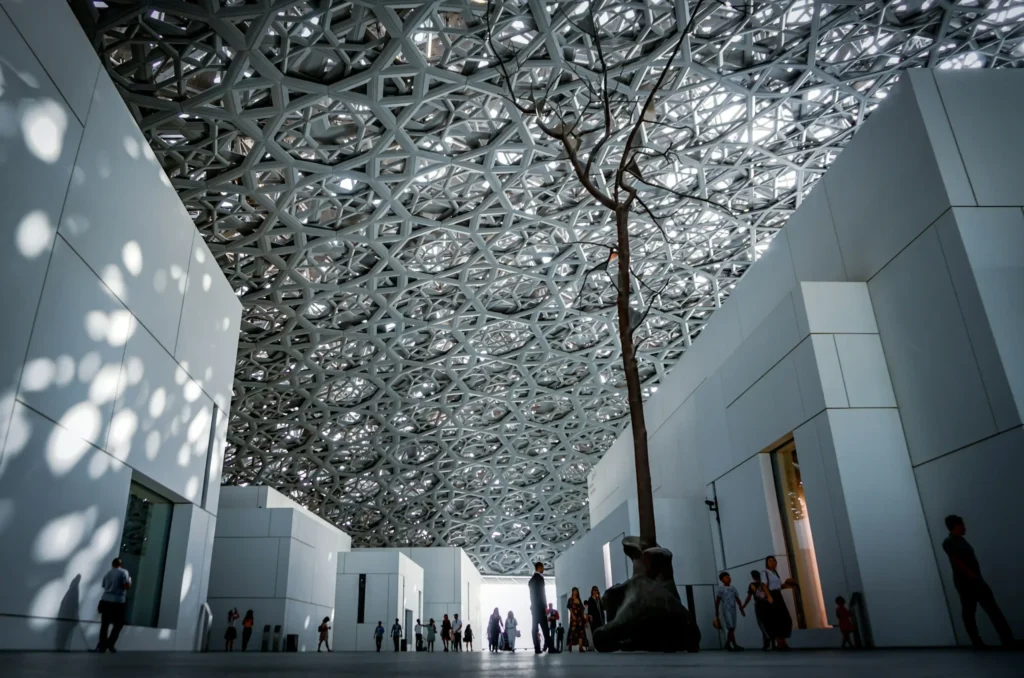
The Architecture of the UAEA Journey Through Arabian Nights Reimagined for the Modern Era By Janhavi Gusani The evolution of the United Arab Emirates, from sands to skylines, is more than an architectural transformation. It is a symphony of heritage and innovation, a living narrative where the poetry of the past converses with the promise of the future. The UAE’s landscape, once defined by dunes and desert winds, now rises in shimmering glass, marble, and steel, yet still hums with the spirit of the desert that shaped it. This is the land of visionaries who dared to dream amid the vast emptiness, turning grains of sand into foundations of global marvels. The desert has always been more than a backdrop here, it is a teacher, a muse, and a silent witness to the endurance and imagination of its people. Each shifting dune carries stories of resilience, patience, and unity, lessons that now echo through the corridors of contemporary Emirati architecture. Before the skyscrapers, there was sand. Before innovation, there was survival. The architecture of the UAE is rooted in its desert identity, one that celebrates simplicity, balance, and connection to nature. The ancient Bedouin wisdom of building with harmony, not against the environment, continues to shape the region’s design philosophy. Traditional Emirati architecture was always sustainable at heart. Homes were oriented to capture the wind, shaded by courtyards and cooled by barjeel wind towers, ingenious structures that predated the modern concept of eco-design by centuries. These wind towers were not merely practical, they embodied an understanding of coexistence between man and nature.  Today, the principles of those early designs breathe within the glass walls of modern villas and the curves of cultural centers. Contemporary architects reinterpret the essence of those wind towers, courtyards, and mashrabiyas to suit modern lifestyles, preserving privacy, inviting light, and fostering community. The architecture of the UAE does not merely preserve identity, it celebrates it on a global stage. From Dubai’s futuristic skyline to Sharjah’s artistic revival and Abu Dhabi’s cultural grandeur, every emirate contributes a chapter to the nation’s architectural story. Each building tells a tale of collaboration, where Emirati tradition meets international artistry.  Materials are sourced from multiple continents, and ideas converge from diverse minds, yet the soul remains profoundly local. The Sheikh Zayed Grand Mosque in Abu Dhabi stands as a radiant embodiment of this philosophy. Constructed by artisans from around the world, it merges influences from Mughal, Persian, and Moorish architecture, uniting over 80 global cultures under one dome of faith and harmony. Its marble courtyards and delicate mosaics are not merely decorative, they narrate the story of a nation built on coexistence. Perhaps no event symbolized the UAE’s architectural narrative better than Expo 2020 Dubai, a celebration of innovation, culture, and human connection. The site itself was an architectural wonder, designed as a city within a city. Each pavilion became a national identity encapsulated in design, from Saudi Arabia’s gravity-defying facade to the Netherlands’ self-sustaining biotope and Singapore’s futuristic vertical gardens.  The Expo was more than a showcase of architecture, it was a living dialogue on how design can drive progress and sustainability. It was the physical manifestation of the UAE’s motto, “Connecting Minds, Creating the Future.” In a world rapidly racing toward digital and artificial intelligence-driven futures, the UAE’s architects are grounding innovation in sustainability. Masdar City, nestled in the heart of the desert, stands as a beacon of this vision.  It draws from the vernacular designs of old Emirati settlements, narrow streets that channel wind, shaded walkways that reduce heat, and mashrabiyas that filter sunlight into patterned serenity. Masdar City is a triumph of mindful engineering. Built with recycled steel and aluminum, powered by renewable energy, and designed for minimal carbon impact, it redefines what it means to build for tomorrow. Here, technology and tradition cohabit, where smart infrastructure coexists with the timeless values of balance and respect for nature. It is not just a city, but a statement, a message that sustainability need not come at the cost of culture. It is the UAE’s architectural poetry written in the language of the future. While the nation’s gaze is fixed firmly on innovation, its heart beats with reverence for heritage. The Sharjah Art Foundation is a shining example of this delicate balance. What were once historical buildings in the old Al Mureijah district have been transformed into dynamic cultural spaces. The Foundation restores rather than replaces, turning courtyards into galleries and wind-towered homes into sanctuaries of creativity. Sharjah’s approach is not to erase history, but to inhabit it, allowing art, performance, and dialogue to thrive within structures that once witnessed the everyday rhythm of Emirati life. It is architecture as memory, revived, not replaced. Few architectural works embody the soul of the UAE like the Louvre Abu Dhabi. Designed by Jean Nouvel, the museum’s geometric dome is inspired by palm fronds woven into traditional arish roofs. As sunlight filters through its intricate lattice, it creates a mesmerizing rain of light, reminiscent of rays piercing through date palms in an oasis. This interplay between nature, culture, and science turns architecture into a sensory experience, a modern ode to the poetry of the desert. Equally striking is Dubai’s Museum of the Future, a structure that appears as if suspended between earth and sky. Shaped like an eye gazing into tomorrow, its facade is engraved with Arabic calligraphy quoting the words of His Highness Sheikh Mohammed bin Rashid Al Maktoum on innovation and vision. The building’s void, its hollow center, symbolizes the unknown future humanity is yet to shape. Every curve, every word inscribed, transforms this museum into a living metaphor of the UAE’s identity, bold, forward-looking, and deeply rooted in its language and legacy. The UAE’s architectural narrative extends beyond glass towers and domes. It reaches for the cosmos. With the Mars Mission and advanced aerospace research facilities, the nation’s design philosophy transcends Earth itself. From sustainable urban planning to laboratories shaping interplanetary exploration, architecture here reflects the UAE’s philosophy to dream