The Architecture of the UAE
A Journey Through Arabian Nights Reimagined for the Modern Era
By Janhavi Gusani
The evolution of the United Arab Emirates, from sands to skylines, is more than an architectural transformation. It is a symphony of heritage and innovation, a living narrative where the poetry of the past converses with the promise of the future. The UAE’s landscape, once defined by dunes and desert winds, now rises in shimmering glass, marble, and steel, yet still hums with the spirit of the desert that shaped it.
This is the land of visionaries who dared to dream amid the vast emptiness, turning grains of sand into foundations of global marvels. The desert has always been more than a backdrop here, it is a teacher, a muse, and a silent witness to the endurance and imagination of its people. Each shifting dune carries stories of resilience, patience, and unity, lessons that now echo through the corridors of contemporary Emirati architecture.
Before the skyscrapers, there was sand. Before innovation, there was survival. The architecture of the UAE is rooted in its desert identity, one that celebrates simplicity, balance, and connection to nature. The ancient Bedouin wisdom of building with harmony, not against the environment, continues to shape the region’s design philosophy. Traditional Emirati architecture was always sustainable at heart. Homes were oriented to capture the wind, shaded by courtyards and cooled by barjeel wind towers, ingenious structures that predated the modern concept of eco-design by centuries. These wind towers were not merely practical, they embodied an understanding of coexistence between man and nature.
Today, the principles of those early designs breathe within the glass walls of modern villas and the curves of cultural centers. Contemporary architects reinterpret the essence of those wind towers, courtyards, and mashrabiyas to suit modern lifestyles, preserving privacy, inviting light, and fostering community.
The architecture of the UAE does not merely preserve identity, it celebrates it on a global stage. From Dubai’s futuristic skyline to Sharjah’s artistic revival and Abu Dhabi’s cultural grandeur, every emirate contributes a chapter to the nation’s architectural story. Each building tells a tale of collaboration, where Emirati tradition meets international artistry.
Materials are sourced from multiple continents, and ideas converge from diverse minds, yet the soul remains profoundly local. The Sheikh Zayed Grand Mosque in Abu Dhabi stands as a radiant embodiment of this philosophy. Constructed by artisans from around the world, it merges influences from Mughal, Persian, and Moorish architecture, uniting over 80 global cultures under one dome of faith and harmony. Its marble courtyards and delicate mosaics are not merely decorative, they narrate the story of a nation built on coexistence.


Perhaps no event symbolized the UAE’s architectural narrative better than Expo 2020 Dubai, a celebration of innovation, culture, and human connection. The site itself was an architectural wonder, designed as a city within a city. Each pavilion became a national identity encapsulated in design, from Saudi Arabia’s gravity-defying facade to the Netherlands’ self-sustaining biotope and Singapore’s futuristic vertical gardens.
The Expo was more than a showcase of architecture, it was a living dialogue on how design can drive progress and sustainability. It was the physical manifestation of the UAE’s motto, “Connecting Minds, Creating the Future.” In a world rapidly racing toward digital and artificial intelligence-driven futures, the UAE’s architects are grounding innovation in sustainability. Masdar City, nestled in the heart of the desert, stands as a beacon of this vision.
It draws from the vernacular designs of old Emirati settlements, narrow streets that channel wind, shaded walkways that reduce heat, and mashrabiyas that filter sunlight into patterned serenity.
Masdar City is a triumph of mindful engineering. Built with recycled steel and aluminum, powered by renewable energy, and designed for minimal carbon impact, it redefines what it means to build for tomorrow. Here, technology and tradition cohabit, where smart infrastructure coexists with the timeless values of balance and respect for nature. It is not just a city, but a statement, a message that sustainability need not come at the cost of culture. It is the UAE’s architectural poetry written in the language of the future.
While the nation’s gaze is fixed firmly on innovation, its heart beats with reverence for heritage. The Sharjah Art Foundation is a shining example of this delicate balance. What were once historical buildings in the old Al Mureijah district have been transformed into dynamic cultural spaces. The Foundation restores rather than replaces, turning courtyards into galleries and wind-towered homes into sanctuaries of creativity. Sharjah’s approach is not to erase history, but to inhabit it, allowing art, performance, and dialogue to thrive within structures that once witnessed the everyday rhythm of Emirati life. It is architecture as memory, revived, not replaced.

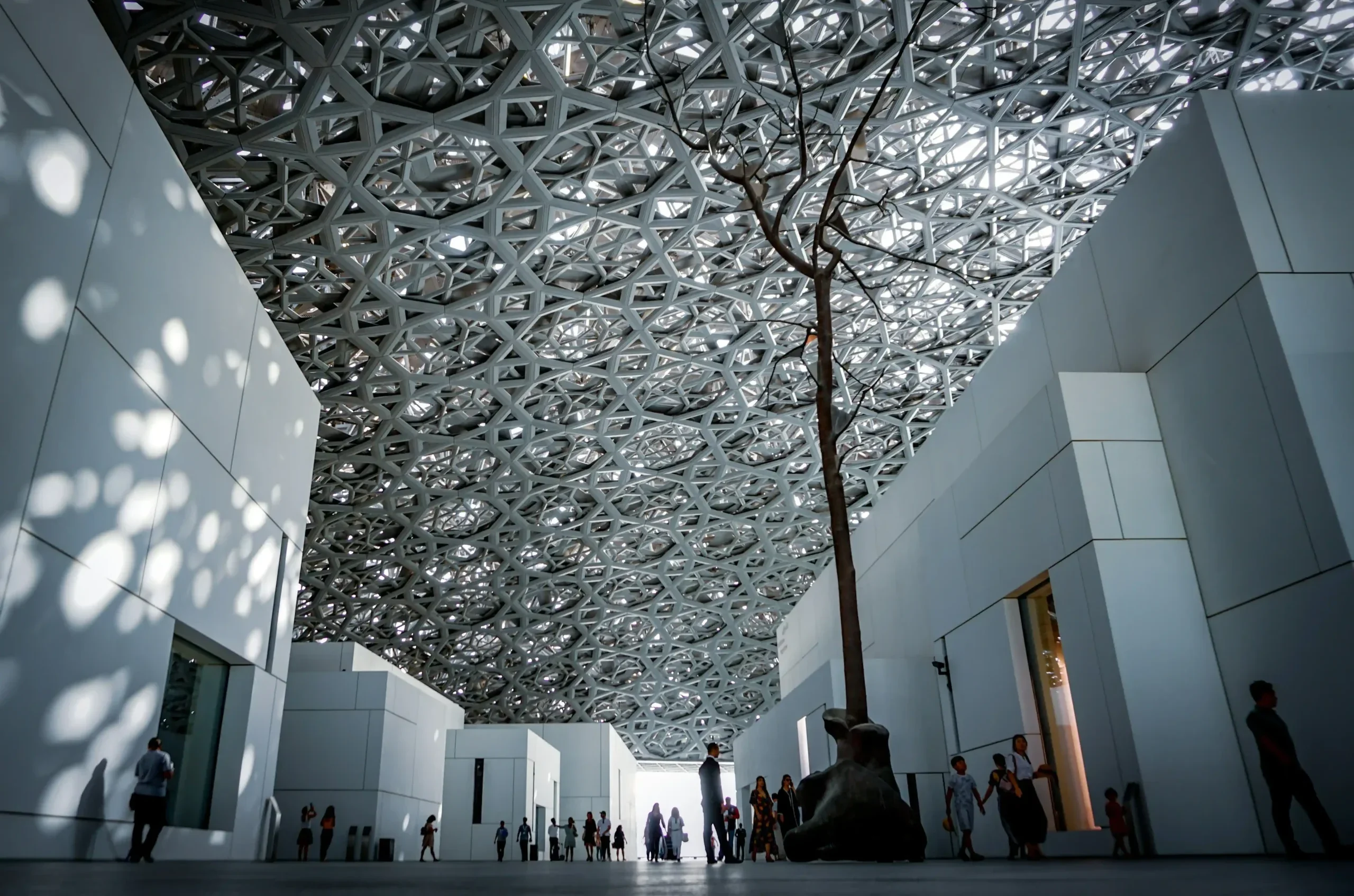
Few architectural works embody the soul of the UAE like the Louvre Abu Dhabi. Designed by Jean Nouvel, the museum’s geometric dome is inspired by palm fronds woven into traditional arish roofs. As sunlight filters through its intricate lattice, it creates a mesmerizing rain of light, reminiscent of rays piercing through date palms in an oasis. This interplay between nature, culture, and science turns architecture into a sensory experience, a modern ode to the poetry of the desert.
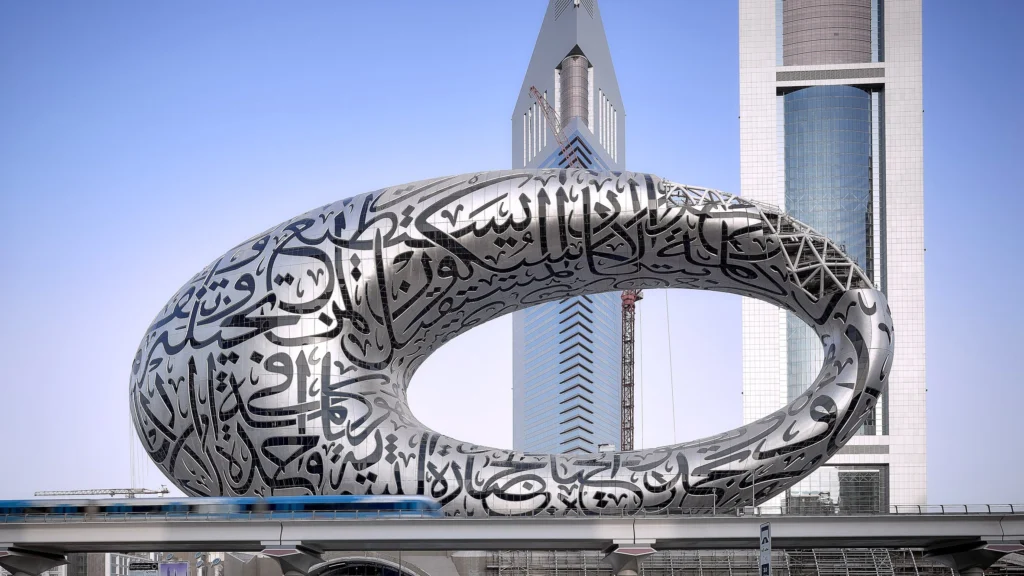
Equally striking is Dubai’s Museum of the Future, a structure that appears as if suspended between earth and sky. Shaped like an eye gazing into tomorrow, its facade is engraved with Arabic calligraphy quoting the words of His Highness Sheikh Mohammed bin Rashid Al Maktoum on innovation and vision. The building’s void, its hollow center, symbolizes the unknown future humanity is yet to shape. Every curve, every word inscribed, transforms this museum into a living metaphor of the UAE’s identity, bold, forward-looking, and deeply rooted in its language and legacy.
The UAE’s architectural narrative extends beyond glass towers and domes. It reaches for the cosmos. With the Mars Mission and advanced aerospace research facilities, the nation’s design philosophy transcends Earth itself. From sustainable urban planning to laboratories shaping interplanetary exploration, architecture here reflects the UAE’s philosophy to dream without limits, yet build with purpose.

This vision transforms architecture into more than structures. It becomes a reflection of values, unity, progress, and endurance. Whether through the eco-cities of Abu Dhabi, the art districts of Sharjah, or the cloud-touched towers of Dubai, every design tells a singular truth, that the UAE is not merely building spaces, but shaping experiences that redefine what it means to belong to the future.
In the UAE, architecture is not a contest of height or spectacle. It is a dialogue between eras. The courtyards of the past speak to the smart cities of tomorrow. The wind towers whisper to the solar panels. The domes mirror the stars. It is an evolution where heritage is never lost, it evolves, breathes, and continues to inspire.
The story of Emirati architecture is, at its essence, a story of a nation that refused to choose between memory and modernity. It is a bridge between poetry and progress, a golden thread weaving through the dunes, the skylines, and the dreams of its people.
From the desert’s heartbeat to the shimmer of futuristic glass, the UAE’s architectural journey stands as a symbol of what humanity can achieve when vision is guided by respect for culture, for nature, and for time itself.
In every dome and every tower, there lies the same truth, this nation does not just build for today. It builds for centuries to come, crafting not merely skylines, but legacies.