Mohamed Al Khadar Al Ahmed
Leading KEZAD’s Mission to Shape the UAE’s Industrial Future
By Hafsa Qadeer

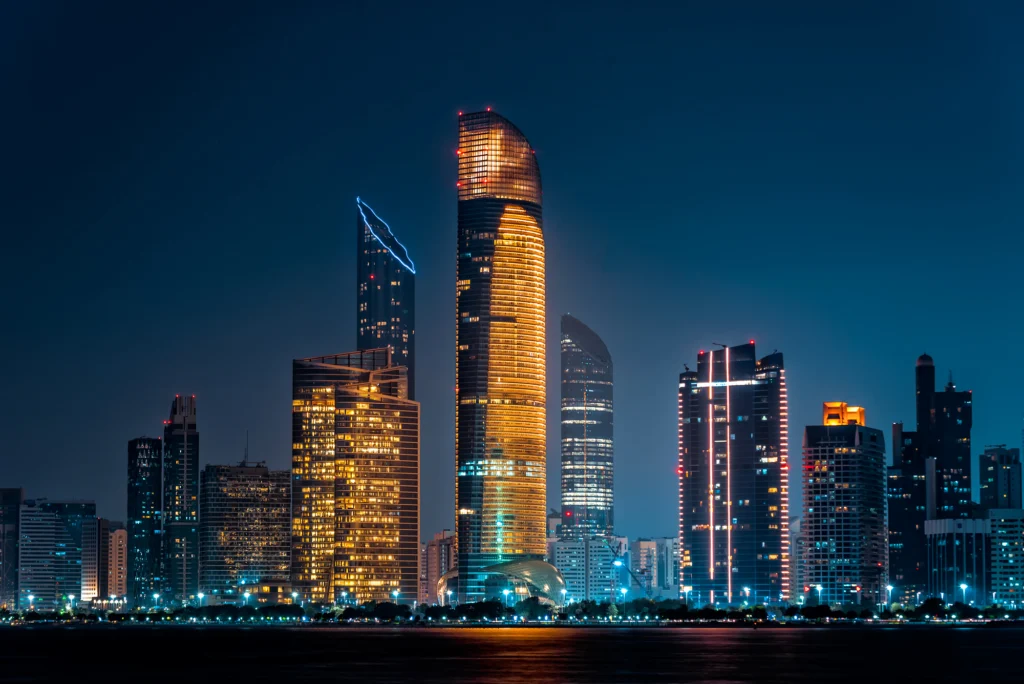
In the quiet expanse between Abu Dhabi’s skyline and the Arabian Gulf, a new industrial frontier is taking shape. Steel meets sunlight, innovation meets intent, and ambition finds its anchor in 550 square kilometres of land designed for one purpose, to reimagine what a modern economic zone can be. This is KEZAD, the Khalifa Economic Zones Abu Dhabi, and at its helm stands Mohamed Al Khadar Al Ahmed, a leader shaping not only the destiny of industries but the economic identity of a nation.
For Al Ahmed, the story of KEZAD is inseparable from the UAE’s grand vision, Centennial 2071, a national strategy that extends far beyond decades, toward a century of resilience, innovation, and global relevance. “KEZAD’s development aligns with the UAE’s Centennial 2071 strategy by fostering economic diversification and moving the nation toward a knowledge-based economy,” he explains. “We are championing the UAE’s long-term economic overhaul, driving growth in advanced manufacturing, logistics, and focus sectors such as pharma and life sciences, and food and beverages.
What began as a bold infrastructure project has evolved into a strategic ecosystem that now supports more than 2,150 businesses across 17 sectors, stretching from Abu Dhabi to Al Ain and the Al Dhafra region. With over 100 square kilometres of free zones and a total land bank exceeding 550 sq km, KEZAD is not just an industrial park, it is the largest integrated economic zone in the country, a living embodiment of the UAE’s ambition to build beyond oil and beyond borders.
A Hub for Global Trade in an Age of Uncertainty
In an era where global trade faces turbulence, from supply chain disruptions to geopolitical shifts, KEZAD stands as a stabilising force. Free zones, Al Ahmed believes, are more vital than ever. “Free zones have regained importance as key enablers for the UAE’s national transformation programmes,” he says. “They offer investors access to infrastructure, facilities, and ancillary services, along with 100% ownership, full profit repatriation, and exemption from corporate and income taxes.”
But KEZAD’s true advantage lies in geography and integration. Its proximity to Khalifa Port, one of the region’s most advanced deep-water ports, and direct connection to Etihad Rail create a multimodal transport network linking sea, land, and air. “It’s not just about logistics,” Al Ahmed adds. “It’s about resilience, about ensuring the efficient and reliable movement of goods even in volatile markets.”
That connectivity positions the UAE as a bridge between continents, serving two-thirds of the world’s population within an eight-hour flight. From KEZAD’s warehouses and factories, raw materials flow in, products flow out, and ideas move seamlessly between Asia, Africa, and Europe, reaffirming the UAE’s place as a global connector.


Balancing Global Investment and Local Empowerment
While global corporations see KEZAD as a gateway to the Middle East, Al Ahmed is equally focused on nurturing homegrown enterprises. “SMEs are the backbone of economies that foster innovation, employment, and resilience,” he says.
To that end, KEZAD’s Entrepreneurship and Incubation Centre provides cost-effective workspaces and flexible licensing, empowering startups to scale from concept to commercial success. The centre, alongside partnerships with institutions like the Emirates Growth Fund, helps bridge access to capital and mentorship, critical ingredients in the UAE’s evolving SME ecosystem.
This dual strategy, welcoming global giants while cultivating local innovators, is core to KEZAD’s philosophy. “Our integrated ecosystem encourages collaboration between SMEs and multinational corporations,” Al Ahmed explains. “We want synergy, not separation.”
The numbers tell the story: SMEs currently account for 86% of private-sector jobs and 63.5% of the UAE’s non-oil GDP. KEZAD’s ecosystem ensures that as international capital flows in, local talent and enterprise grow with it, forming an economy that is both open and self-sustaining.
Green Industry and the ESG Imperative
Industrial growth without environmental responsibility, Al Ahmed insists, is no longer growth at all. Under his leadership, KEZAD has woven sustainability and ESG principles into its very infrastructure. “Our approach is proactive and multifaceted,” he notes. “We support businesses in adopting cleaner energy sources and integrating solar power within their zones.”
Indeed, companies like Abundance Solar Panel Industries, which recently signed a 50-year lease to build a solar panel plant worth AED 55 million, reflect KEZAD’s tangible commitment to renewables. Yet, Al Ahmed’s vision is pragmatic as much as it is progressive. “The transition to a low-carbon economy requires interim solutions,” he explains. “That’s why we’ve also invested in a 30-kilometre natural gas network in Al Ma’mourah, ensuring reliability while advancing toward green goals.”
This blend of innovation and realism defines KEZAD’s sustainability strategy. It is not a marketing exercise but a measurable, operational commitment, aligned with the Abu Dhabi Climate Change Strategy and designed to support tenants in reducing emissions without sacrificing competitiveness.
Innovation in the Age of Industry 4.0
The factories of the future are not powered by steam or steel, they run on data, intelligence, and connectivity. Recognising this, KEZAD is investing heavily in AI, automation, and Industry 4.0 initiatives to position itself at the frontier of the digital industrial revolution.

“Our partnership with Siemens Advanta is a cornerstone of that strategy,” says Al Ahmed. Through digital transformation assessments and technology roadmaps, Siemens is helping KEZAD’s industrial clients optimise operations, adopt automation, and implement smart manufacturing systems.
Another partnership with Silal focuses on agricultural technology (AgTech), launching projects in Al Ain Industrial City that combine AI, sustainability, and food security. “We are fostering an environment where startups, SMEs, and multinational enterprises can collaborate to drive vertical innovation,” Al Ahmed adds. “This is the new DNA of KEZAD, innovation-led and future-focused.”

Circular Economy as a New Industrial Ethic
The circular economy is not just an environmental imperative, it is an economic opportunity, and KEZAD is determined to lead that transformation. Across its clusters in polymers, metals, and food processing, KEZAD is designing systems where waste becomes value, and by-products find second lives.
“Our industrial ecosystems are designed to enable symbiotic relationships,” Al Ahmed explains. “The by-products of one company can become the inputs for another.” This philosophy is turning KEZAD into a regional hub for circular practices, integrating sustainability at every point in the value chain, from production to packaging.
The vision extends to logistics and manufacturing, with resource efficiency and recycling embedded into both policy and design. “We are not just addressing the circular economy,” he says, “we are enabling it.”

Sectors of the Future
Where Investment Meets Impact
Beyond traditional industries, Al Ahmed sees tremendous potential in emerging sectors. “E-commerce is redefining logistics in the MEASA region,” he notes. Companies like Amazon and Noon already anchor KEZAD’s digital economy ecosystem, and demand for automation and fulfilment centres continues to surge.
The packaging sector is also evolving. Projects like Star Paper Mill, a 59,000-square-metre facility producing recycled kraft paper reels, underscore a shift toward eco-friendly manufacturing. Meanwhile, DesertBoard’s Palm Strand Board, a plant converting palm fronds into engineered wood, illustrates KEZAD’s belief in innovation rooted in sustainability.
Food security remains another strategic pillar. “KEZAD’s scale and infrastructure make it a natural hub for advanced Agtech,” says Al Ahmed. “Vertical farming, hydroponics, and climate-resilient greenhouses are all part of the picture.” As the UAE targets to double the digital economy’s contribution to GDP by 2032, KEZAD is positioning itself as a nerve centre for digital logistics, automation, and advanced industry, turning policy goals into tangible growth.
Stability, Security, and the Promise of Predictability
In a world where volatility has become the norm, KEZAD offers something increasingly rare: certainty. “Industrial companies today prioritise stability, predictability, and resilience alongside growth,” Al Ahmed observes. “We provide that through location, policy, and infrastructure.”
Abu Dhabi’s status as the world’s safest city, a title it has held for nine consecutive years according to Numbeo, reinforces KEZAD’s appeal. But safety here extends beyond security, it means economic predictability, efficient licensing, and a one-stop shop that cuts through bureaucratic complexity.
“Security means nothing if the supply chain is fragile,” Al Ahmed says. “Our integrated zones reduce reliance on single trade corridors and diversify risk. That’s what makes KEZAD a truly future-ready ecosystem.”
Redefining Success: Beyond Numbers
For Al Ahmed, success cannot be reduced to the number of leases signed or square metres developed. “Success is defined by KEZAD’s contribution to a diversified, resilient, and globally competitive economy,” he reflects. “It’s about moving beyond an economy based on a single resource and building a foundation for the future.”
That future is human as much as it is industrial. KEZAD’s initiatives to cultivate Emirati talent, through collaborations with Khalifa University and Zayed University, and alignment with Operation 300bn and the Make it in the Emirates initiative, reflect a belief that infrastructure and intellect must evolve together. “We are building the human capital that will carry this vision forward,” he says. “It’s about preparing the next generation to lead.”
In Al Ahmed’s eyes, success is seeing a local SME grow into a regional exporter; it’s witnessing a young Emirati engineer manage a complex industrial project. “KEZAD is a living classroom,” he says with quiet pride, “where global best practices are transferred, and future leaders are forged.”
Leadership Lessons for a Global Future
Perhaps the greatest lesson from KEZAD’s journey lies in the power of integration. When KIZAD and ZonesCorp merged in 2022, it wasn’t merely a structural realignment, it was a statement of intent: unity breeds efficiency. The merger created a single-window experience for investors, simplifying business setup and amplifying scale.
That same ethos drives KEZAD’s expansion strategy today. The organisation’s warehouse utilisation rate reached 98% in Q2 2025, reflecting surging demand for quality logistics infrastructure. To meet it, KEZAD is adding 157,000 square metres of new warehousing and adopting automation and smart inventory systems to enhance efficiency.
Industrial clustering, grouping related industries within close proximity, has emerged as another critical success factor. “When metal manufacturers, polymer producers, and food processors operate near one another, they create synergy,” Al Ahmed notes. “It reduces costs, accelerates innovation, and builds resilience.”
The model has already inspired other regions aiming to build sustainable industrial hubs. The lesson, Al Ahmed says, is simple but profound: “Economic zones must evolve from isolated industrial parks into living ecosystems. That’s where the real transformation begins.”
The Human Capital Horizon
KEZAD’s growth story would be incomplete without its parallel investment in people. Al Ahmed envisions KEZAD not just as a logistical powerhouse, but as a cradle of industrial talent. Through structured partnerships with academic institutions and government entities, the group is creating pathways for Emirati youth to gain hands-on experience in engineering, supply chain management, and technology.
“Our talent programmes are a direct contribution to the UAE’s Emiratisation strategy,” he says. “They equip citizens with the skills needed to lead the industries of tomorrow.”
As the UAE accelerates toward Centennial 2071, KEZAD’s role extends far beyond economic diversification. It is shaping the culture of modern industrial leadership, one that prizes sustainability, innovation, and inclusivity.
A Vision Rooted in Purpose
As the interview draws to a close, Al Ahmed reflects on what drives him most. “For me, leadership is about legacy,” he says. “Not personal legacy, but national legacy, ensuring that what we build today will still serve the UAE a hundred years from now.”
That sentiment captures the essence of KEZAD’s mission. It is not merely a zone, it is a vision realised in steel and soil, a strategic nerve centre that translates the UAE’s aspirations into action.
In every warehouse, factory, and innovation cluster across KEZAD’s vast expanse lies a fragment of the nation’s future. And in the careful hands of Mohamed Al Khadar Al Ahmed, that future is being built, not hastily, but purposefully, one sustainable step at a time.