The Classic Traditional Sweet Present at Festivals Throughout the Emirates, Inside the Heart and Soul of the Luqaimat
By Hafsa Qadeer
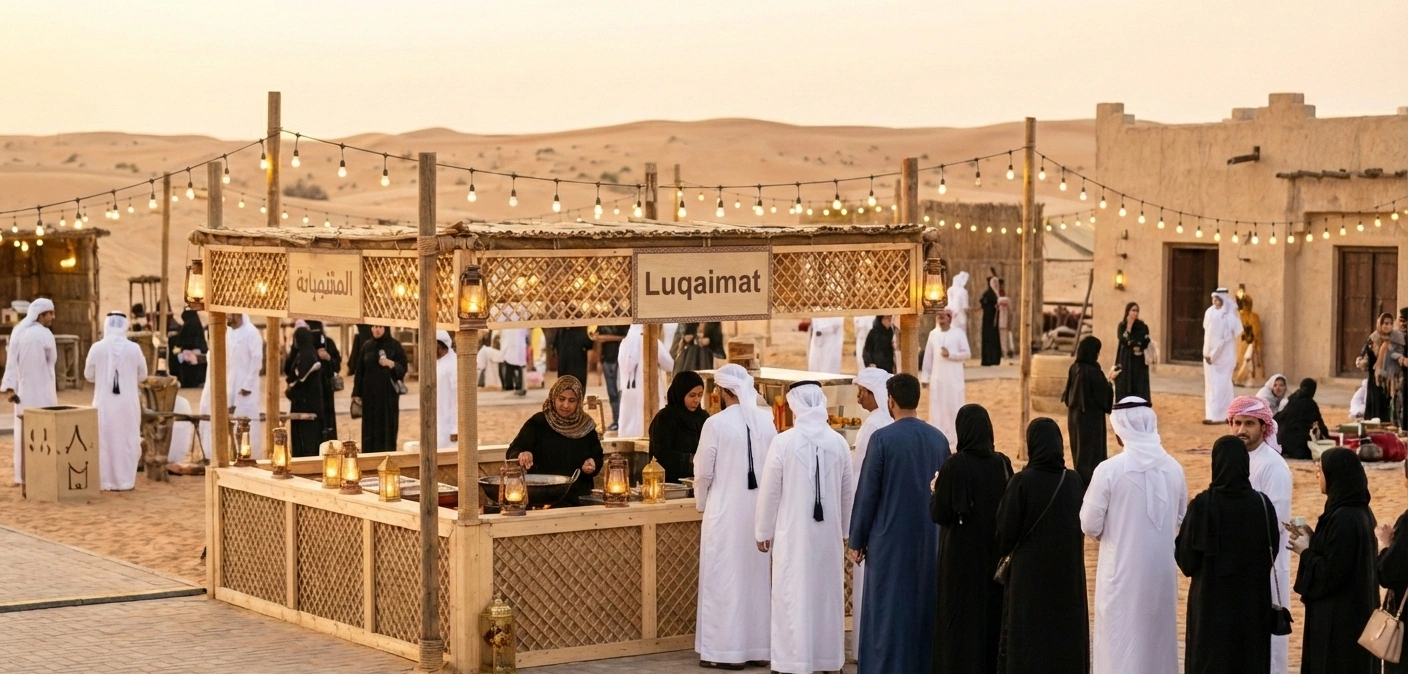
The Classic Traditional Sweet Present at Festivals Throughout the Emirates, Inside the Heart and Soul of the LuqaimatIf you find yourself wandering through the labyrinthine alleyways of the Al Hosn Festival in Abu Dhabi, or navigating the vibrant, neon-lit stalls of Global Village in Dubai, your senses will inevitably be hijacked by a singular, intoxicating aroma. It is a fragrance that defies the arid desert air, a heavy, sweet perfume of toasted saffron, the sharp, medicinal warmth of green cardamom, and the deep, caramelized musk of date syrup. Follow that scent to its source, and you will find the true heartbeat of Emirati hospitality. There, usually presided over by a group of formidable women whose hands move with the rhythmic precision of a master percussionist, sits a wide, bubbling vat of oil. With a flick of the wrist, small spheres of dough are launched into the heat. They bob, they spin, and they transform from pale ivory to a majestic, burnished gold. This is the Luqaimat. To the uninitiated, it is merely a fried dough ball. To the Emirati, it is a vessel of history, a symbol of survival, and the undisputed king of the festival table.
The Ancient Pedigree of a Desert Delight
To truly understand Luqaimat is to understand the history of the Silk Road and the profound culinary cross-pollination of the Middle East. While we claim it today as a quintessential Emirati treasure, its DNA stretches back to the 13th-century Abbasid Caliphate. Known in classical Arabic as Luqmat al-Qadi, translated literally as “The Judge’s Morsel, it was said to be so delicious that a judge, upon tasting one, would find his mood instantly lightened, perhaps even influencing a favorable verdict in the courts of old Baghdad. As the recipe traveled along the trade routes, it found a permanent home in the coastal and desert settlements of the Trucial States. In the pre-union days, before the skyscrapers of Dubai pierced the clouds and the oil wealth transformed the landscape, sweetness was a luxury of the highest order.
In the harsh environment of the desert or the demanding, salt-crusted life of a pearl diver, calories were more than just sustenance; they were precious energy. The Luqaimat represented a celebration of rare and imported ingredients. Flour, yeast, and oil were staples, but the addition of saffron, plucked from the crocus flowers of the Iranian plateau, and cardamom from the Malabar Coast of India spoke of a nation that sat at the crossroads of global maritime trade. Today, as the United Arab Emirates celebrates its status as a global hub of modernization, the Luqaimat remains an anchor. It is the culinary glue that binds the generation of the Bedouins, who remembers the silence of the dunes, to the generation of the digital age, who navigates the heights of the Burj Khalifa.
A Masterclass in Manual Dexterity
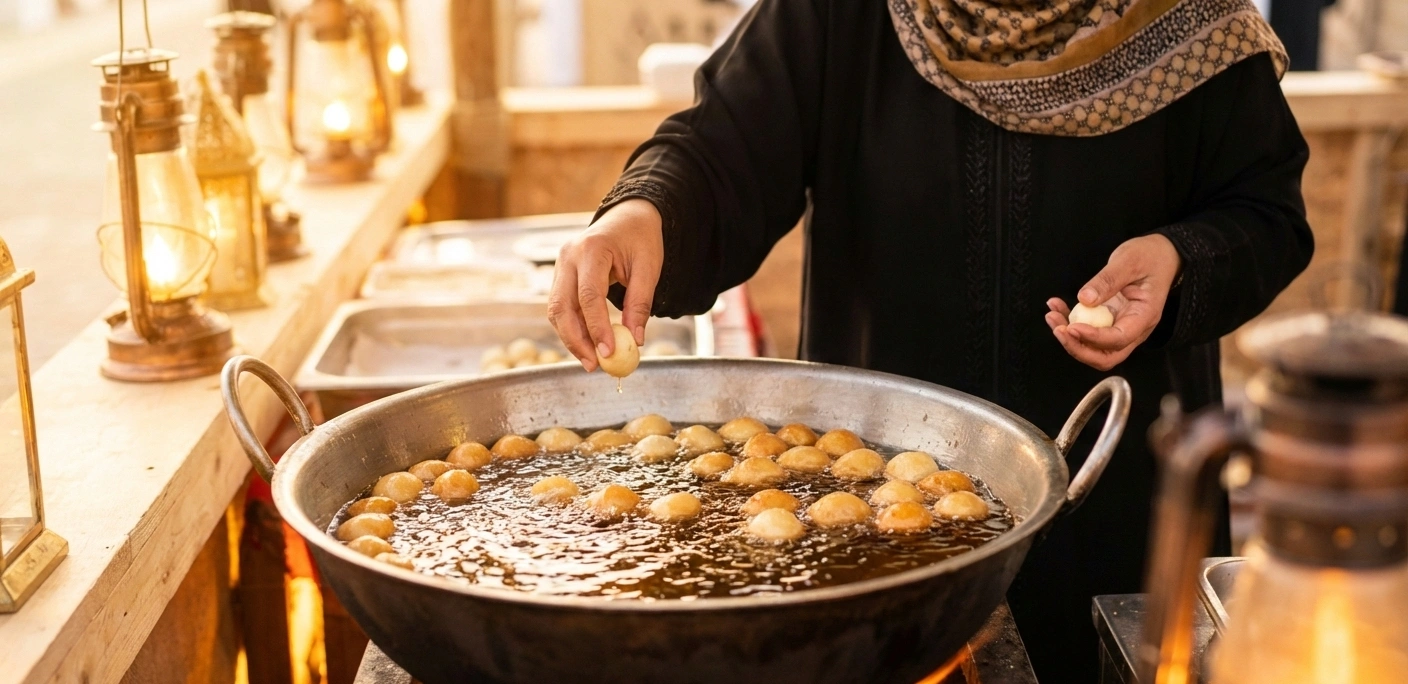
There is a specific, mesmerizing theater to the preparation of Luqaimat that no modern machinery or industrial assembly line can replicate. At any cultural festival, the Luqaimat station is the primary attraction, often drawing longer queues than the modern food trucks parked nearby. The women who man these stations are the keepers of the national flame. Watching them is a lesson in fluid dynamics and human dexterity. The batter is notoriously difficult to handle; it must be elastic enough to stretch but firm enough to hold a sphere. The cook dips her left hand into a bowl of water to prevent sticking, then grabs a fistful of the sticky, fermented dough. With a calibrated squeeze of her thumb and forefinger, she pops a perfect sphere into the shimmering oil.
It happens in milliseconds, a rapid-fire performance of rhythmic movement that fills the fryer with dozens of identical spheres in under a minute. As they fry, they are constantly agitated with a long-handled slotted spoon. This constant movement is the secret to their architecture; it ensures the ball is cooked evenly on all sides, resulting in a shell that is thin and glass-crisp, while the interior remains a soft, yeasty honeycomb of air. This texture is the hallmark of a master. A Luqaimat that is too dense is a failure; one that is too oily is a tragedy. It must be a morsel in every sense, a light, ephemeral bite that disappears almost as soon as it hits the tongue, leaving behind only the lingering warmth of the spices.
The Holy Trinity of Aromatics
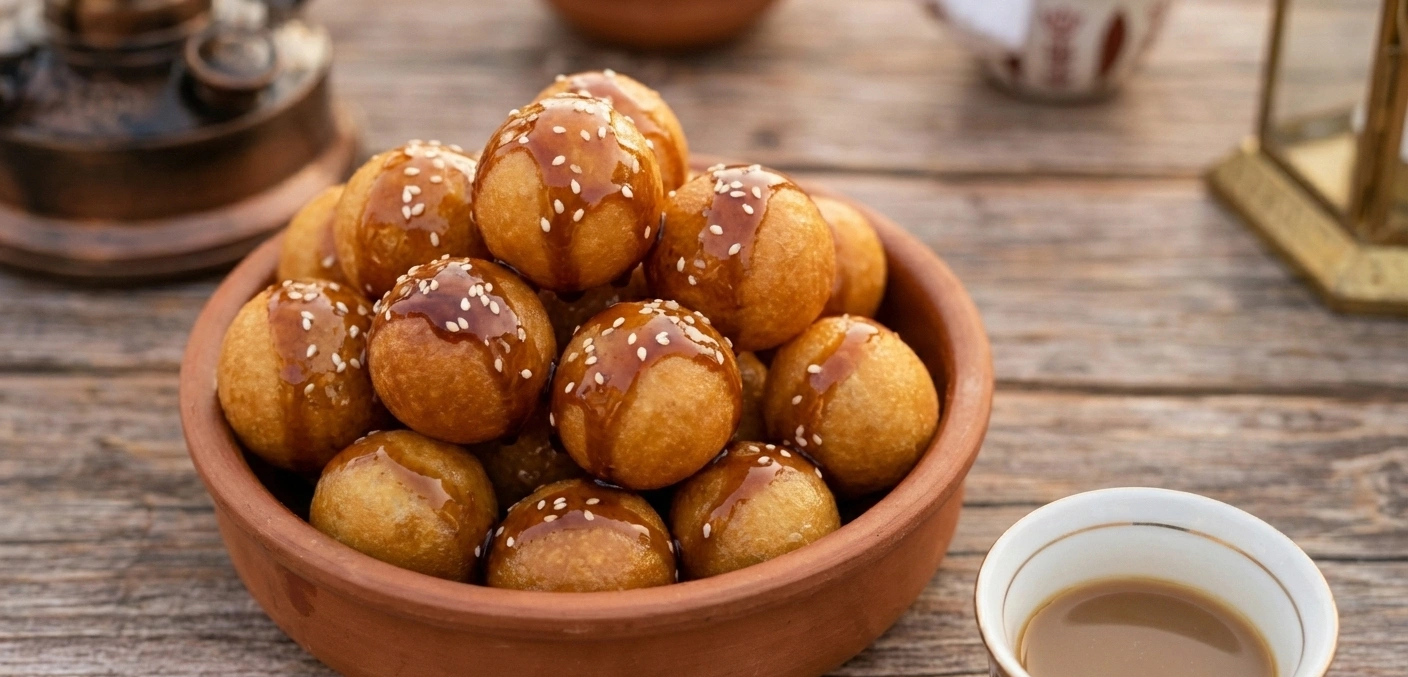
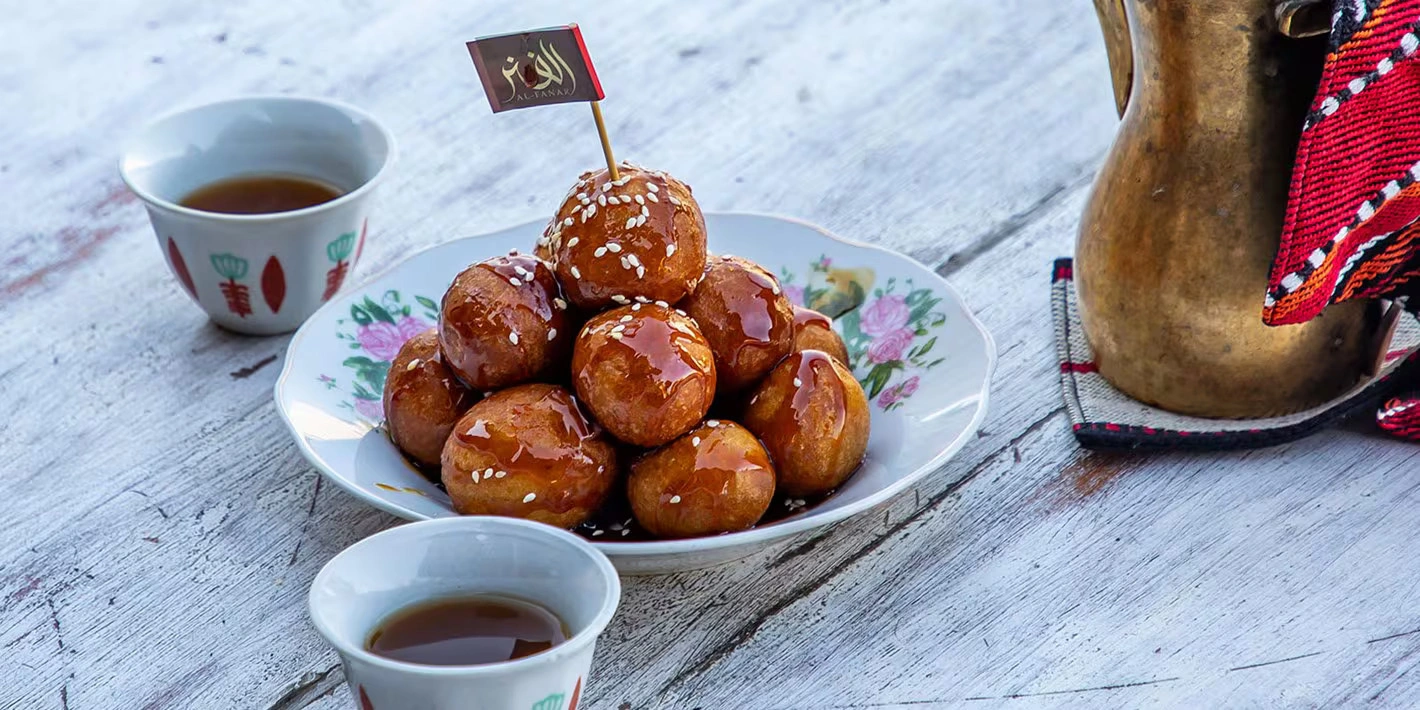
What separates the Emirati Luqaimat from its global cousins, the Greek Loukoumades, the Turkish Lokma, or even the Indian Gulab Jamun, is the unapologetic boldness of its finishing. While other cultures might use a clear honey syrup or a simple dusting of powdered sugar, the Emirati version is rooted in the “Tree of Life.” Once the golden balls are drained of excess oil, they are not merely drizzled; they are baptized in Dibs. This is a thick, viscous, and intensely dark syrup made from boiled-down dates. It is the black gold of the Emirati kitchen, tasting of dark chocolate, molasses, and sun-drenched fruit.
Unlike honey, which sits on the surface, the warm Dibs seeps slightly into the fragile crust, creating a tacky, rich coating that demands the diner abandon all pretense of using forks. The date palm has provided for the people of this region for millennia, offering shade, building materials, and life-sustaining fruit. By using Dibs, the Luqaimat becomes an extension of the land itself. The final act is a generous shower of toasted white sesame seeds. They provide a nutty counterpoint to the deep sweetness of the dates and a tiny, architectural crunch that complements the snap of the dough. When served alongside Gahwa, the bitter, cardamom-infused Arabic coffee, the balance is perfect. The bitterness of the coffee cleanses the palate, making the next sweet bite feel as fresh as the first.
The Pulse of the Festival
The Luqaimat is not a solitary snack; it is a communal event. Its presence is mandatory at every major milestone of the Emirati calendar. During the Holy Month of Ramadan, the sweet takes on a spiritual quality. As the sun dips below the horizon and the Adhan echoes across the cities, families break their fast with water and a few dates, but the Luqaimat is the reward that follows the prayer. It is the centerpiece of the Iftar table, served in towering piles that disappear within minutes as neighbors visit one another. The sugar from the dates provides a rapid restoration of energy, while the warmth of the fried dough offers comfort after a day of reflection.
On the second of December each year, as the country turns into a sea of red, green, white, and black for National Day, the Luqaimat becomes a tool of cultural diplomacy. In schools, government offices, and neighborhood tents, it is served to locals and expatriates alike. To share a bowl of Luqaimat is to participate in the “Spirit of the Union.” It is a dish that says, “We are proud of where we came from, and you are welcome to taste our history.” In this context, the sweet is more than food; it is an invitation into the Emirati home, a gesture of radical hospitality that has survived the transition from the tent to the villa. It represents a shared identity in a country where change is the only constant.
Tradition versus the Nutella Revolution
Like all great cultural icons, the Luqaimat is currently navigating a mid-life transformation. The youth of the UAE, the “Majlis Generation”, are reimagining the sweet for a globalized, social-media-heavy palate. Walk into a trendy cafe in Dubai’s Jumeirah district or a neon-lit food truck in Abu Dhabi’s Khalifa City, and you will find the “modern” Luqaimat. The traditional Dibs is often cast aside in favor of melting Nutella, Lotus Biscoff spreads, or pistachio creams. Some modern iterations are even stuffed with cubes of cream cheese, creating a savory-sweet explosion that has become a sensation among the younger demographic.
Purists often scoff at these developments, arguing that a Luqaimat without date syrup is a betrayal of its desert roots. However, this evolution is precisely what keeps the dish relevant in a fast-changing world. It has moved from the grandmother’s kitchen to the boutique street-food scene without losing its essential identity. Even when served in a gold-plated box from a high-end bakery, the fundamental joy of the Luqaimat remains its simplicity. It is still a ball of dough, a splash of oil, and a moment of shared sweetness. The diversification of toppings is not its end, but rather its expansion, a way for the dish to travel into the hearts of a new, international audience that might find the earthy intensity of date syrup an acquired taste.
A Communal Compass in a High-Speed Nation
Beyond the sugar and the oil, there is a deeper reason why this dish holds such a grip on the national psyche. In a country where over eighty percent of the population are expatriates, food becomes a vital marker of identity and “home.” For the Emirati, the Luqaimat is a sensory bridge. It is the taste of a Friday afternoon at their grandmother’s house in the desert. It is the memory of a simpler time before the relentless pace of 21st-century life took hold. For the expatriate, it is the most accessible entry point into a culture that can sometimes feel private and shielded behind the walls of traditional majlis gatherings.
There is also the “slow food” aspect of the dish. In a nation that prides itself on being at the forefront of the future, the Luqaimat forces a pause. You cannot easily eat a single Luqaimat on the go while checking emails. They are served in bowls meant for many hands, designed to be shared over long, winding conversations. You wait for them to be fried, you wait for the syrup to be poured, and you wait for them to cool just enough so they don’t burn your tongue. In this waiting, community is built. The queue at the Luqaimat stall is where people from all walks of life, CEOs and construction workers, locals and tourists, stand together, united by the anticipation of that golden crunch.
The Future of the Golden Orb
As the UAE continues to position itself as a global leader in tourism, innovation, and culinary excellence, the Luqaimat is traveling further afield. We are seeing Emirati chefs take this humble street food to culinary competitions in London, Paris, and New York. It is no longer just a “fried sweet”; it is a culinary ambassador, a small but mighty representative of a culture that refuses to forget its origins. The Luqaimat proves that you do not need complex techniques or expensive ingredients to create something that resonates across generations. All you need is a bit of flour, the warmth of the sun in the form of saffron, and the sweetness of the desert in the form of dates.
No matter how many Michelin-starred chefs try to deconstruct it, or how many food trucks “re-skin” it with trendy toppings, the best Luqaimat will always be the one you find at a dusty heritage festival. It will be the one served in a simple plastic bowl, drenched in enough date syrup to make your fingers stick together, handed to you by a woman whose smile is as warm as the oil she cooks in. In the golden crunch of a Luqaimat, you don’t just taste sugar. You taste the resilience of the Bedouin, the history of the spice routes, and the enduring warmth of a culture that defines itself through its hospitality. The Luqaimat is, and will always be, the golden thread in the tapestry of the Emirates, a sweet, round reminder that some traditions are simply too delicious to ever let go.
As the sun sets over the dunes and the festival lights begin to twinkle, the sizzle of the fryer remains a constant. It is a sound that signals more than just the preparation of a dessert; it is the sound of a story being told, one golden morsel at a time. To eat a Luqaimat is to consume a piece of the Arabian soul, a legacy of sweetness that has survived centuries and will undoubtedly thrive for centuries more.