Nagham Debal,
The Quiet Reinvention of Arabic Sound
By Natalia Davis
Picture stepping into a hotel room that seems to already know you. The lights glow with your favorite warm hue, a playlist you love hums softly in the background, and a screen gently suggests a massage to ease your travel fatigue before you’ve even unzipped your suitcase. This isn’t a scene from a futuristic film; it’s a glimpse into the emerging reality of travel. The world of tourism and hospitality is transforming rapidly, blending innovation with personalization to create experiences that are not only enjoyable but also sustainable and deeply tailored to individual preferences. From artificial intelligence that acts as your intuitive travel companion to virtual explorations that allow you to wander through destinations before you book, the future of travel promises to be more exciting, more personal, and more responsible than ever before.
In Dubai, where the pace is relentless and the cultural mix is part of everyday life, some artists arrive looking for space and end up finding a sharper version of themselves. For Syrian qanun player Nagham Debal, the city did not simply offer a stage. It changed the way she listened, performed, and thought about music itself.
“Living in Dubai has been a transformative experience,” she says. “Its cultural diversity allowed me to see music as a universal language rather than a local expression.” That line captures something essential about Debal’s work. She is rooted in the Eastern sound world, but she does not treat tradition as a sealed room. She treats it as something alive, something that can travel, bend, and still remain recognisable.
That approach matters, especially now, when Arabic music is being pulled in different directions at once. There is nostalgia on one side, trend-driven experimentation on the other, and a growing appetite for sounds that feel authentic without sounding trapped in the past. Debal is working right in the middle of that tension. She does not speak like an artist trying to decorate heritage for a modern audience. She speaks like someone who has lived inside the tradition long enough to understand that it can expand without losing its weight.
“I began blending the Eastern essence that represents my roots with influences from different cultures,” she says, “shaping a unique artistic identity, one that balances authenticity with openness.”
In Dubai, that balance is not an abstract ideal. It is a survival skill. The city does not ask artists to choose one audience, one language, or one frame of reference. It places all of them in the same room. For a musician, that can be daunting. It can also be liberating. Debal seems to have understood this early. Instead of treating cultural diversity as background noise, she absorbed it into her sound. The result is music that still carries the emotional architecture of the Arab East, but with enough flexibility to speak beyond it.
Her artistic foundation began long before Dubai entered the picture. She grew up in a musical family, which meant that music was not introduced to her as a career goal or an ambition to pursue later in life. It was simply there, woven into the atmosphere of her home. “Being raised in a musical family laid the foundation for my passion,” she says. But there was a second layer to that foundation, and it came from the UAE itself.
“Growing up in a country like the UAE, where art and culture are truly supported, gave me the space to grow and express myself.”
That support, often discussed in broad cultural terms, becomes very concrete in an artist’s life. It shows up in confidence. In rehearsal time. In public platforms. In the willingness to try something that might otherwise be considered unusual. Debal says the environment encouraged her “to step onto the stage with confidence and evolve continuously,” and that confidence is visible in the way she presents herself now: calm, intentional, and fully aware of the image she has built.
There is a temptation, when writing about artists like Debal, to treat the instrument as the central character. The qanun is, after all, a beautiful and demanding instrument, with a long history and a sound that can move from melancholy to brightness in a single phrase. But what makes Debal interesting is not only that she plays it well. It is the way she talks about it, almost as if it speaks for emotions that ordinary language cannot reach.
That is not just a poetic answer. It reveals how she sees her craft. For her, the instrument is not simply a vessel for technique. It is a means of carrying feeling, memory, and texture into the room. She felt a connection to it from a young age, and that early attachment still seems to guide her artistic instincts. She is drawn not only to preserving the instrument’s legacy, but to asking what it can do next.
“Today, I believe the qanun has great potential to re-emerge in a modern context,” she says, “by blending it with contemporary styles and presenting it to a global audience.”
This is where Debal’s work starts to feel especially relevant. Across the Arab world, there is a growing conversation about how heritage instruments can remain present without being confined to museum logic or formal nostalgia. The answer, in Debal’s case, is not to smooth out the qanun’s identity, but to place it in new settings and let it breathe there. That requires not just technical ability, but imagination. It also requires nerve.
Debal is candid about the challenges that come with making a mark in a space where precision, discipline, and credibility matter more than spectacle. She notes that in any field, men and women are present, “yet it is not always expected for women to excel in areas that require high levels of precision and dedication, such as playing the qanun.”
She did not respond by shrinking herself to fit the expectation. She responded by building a style that would be impossible to ignore. “My focus was on growth and innovation,” she says. Over time, that focus helped her establish a presence that is not borrowed from anyone else’s template.
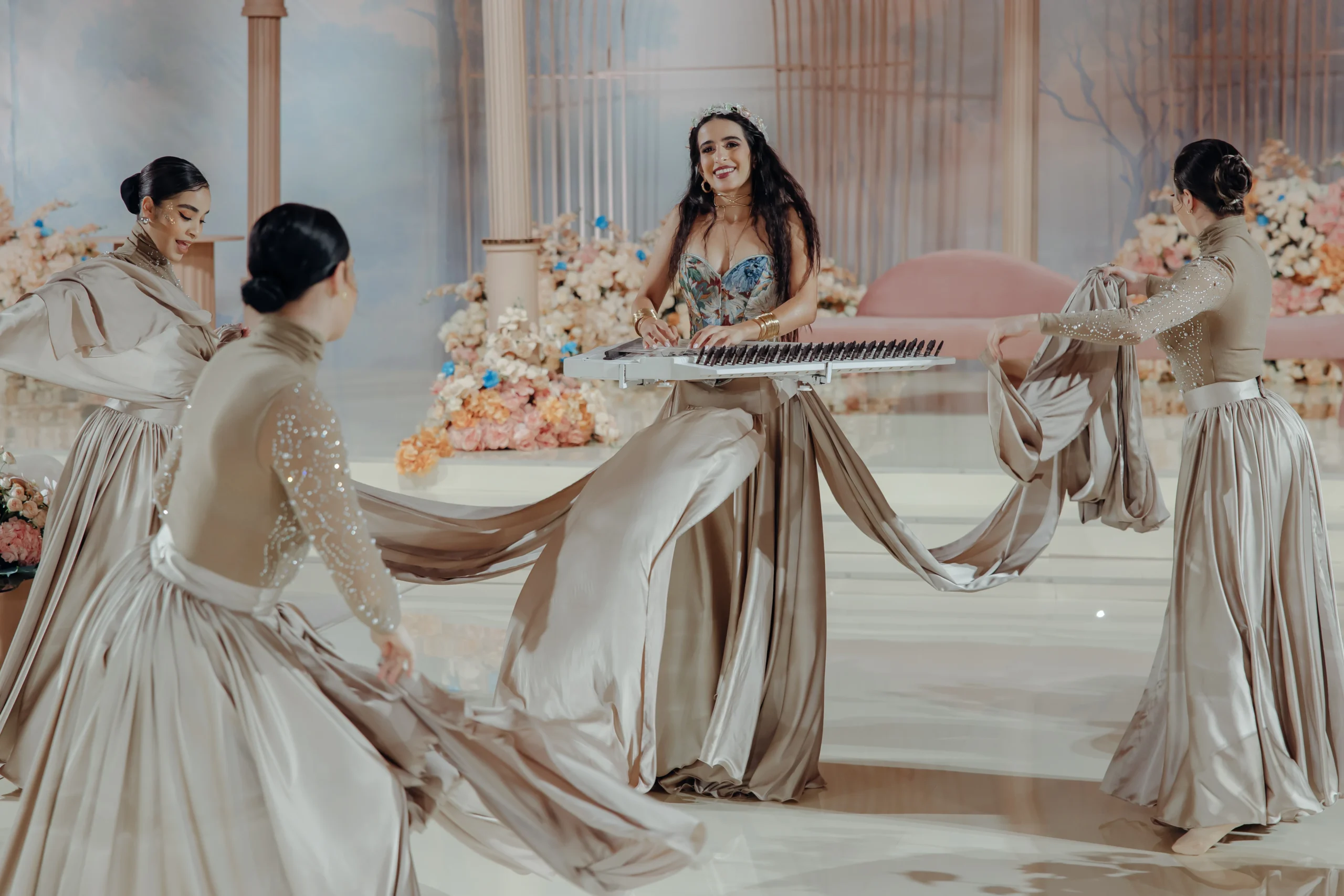
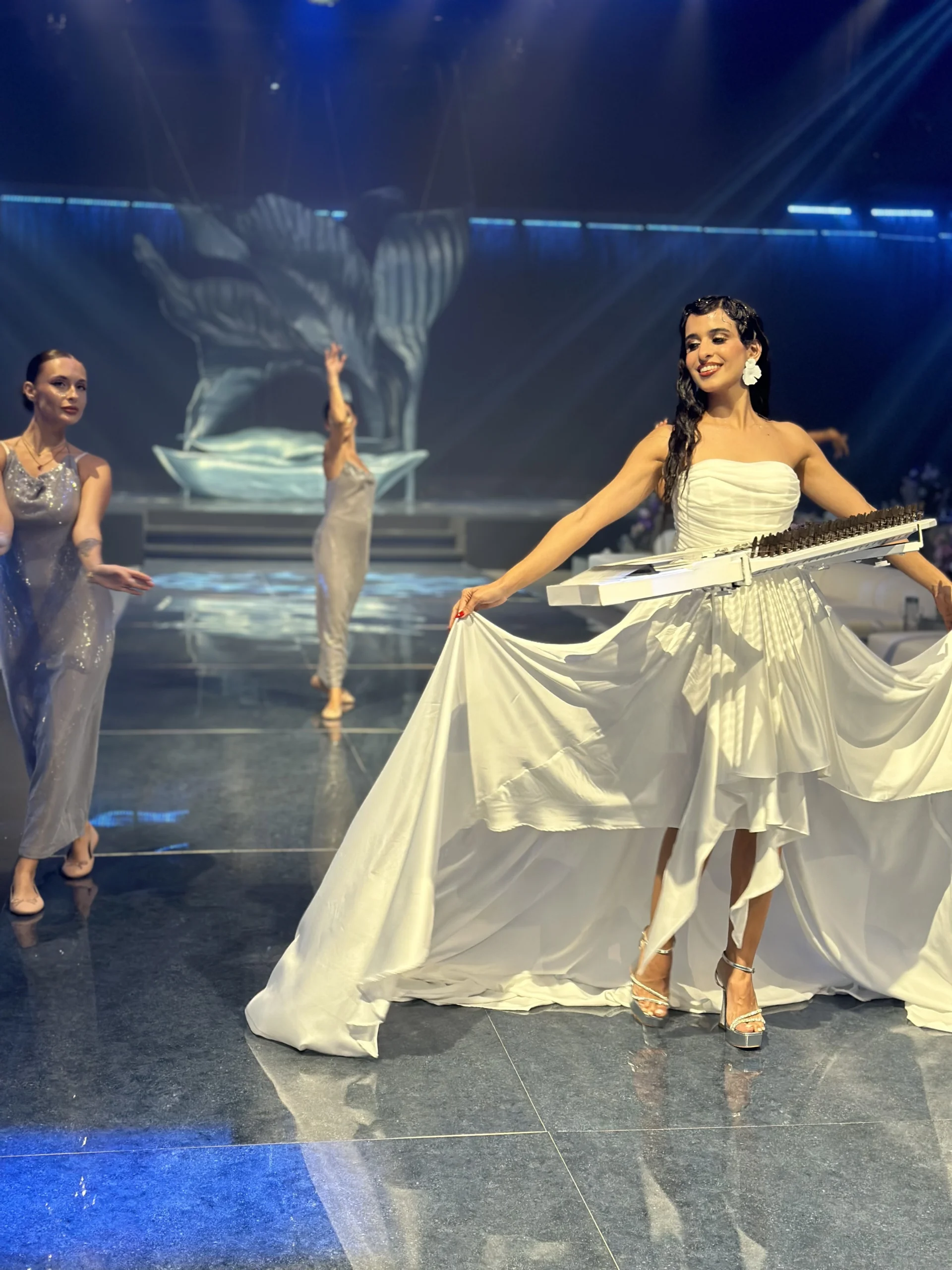
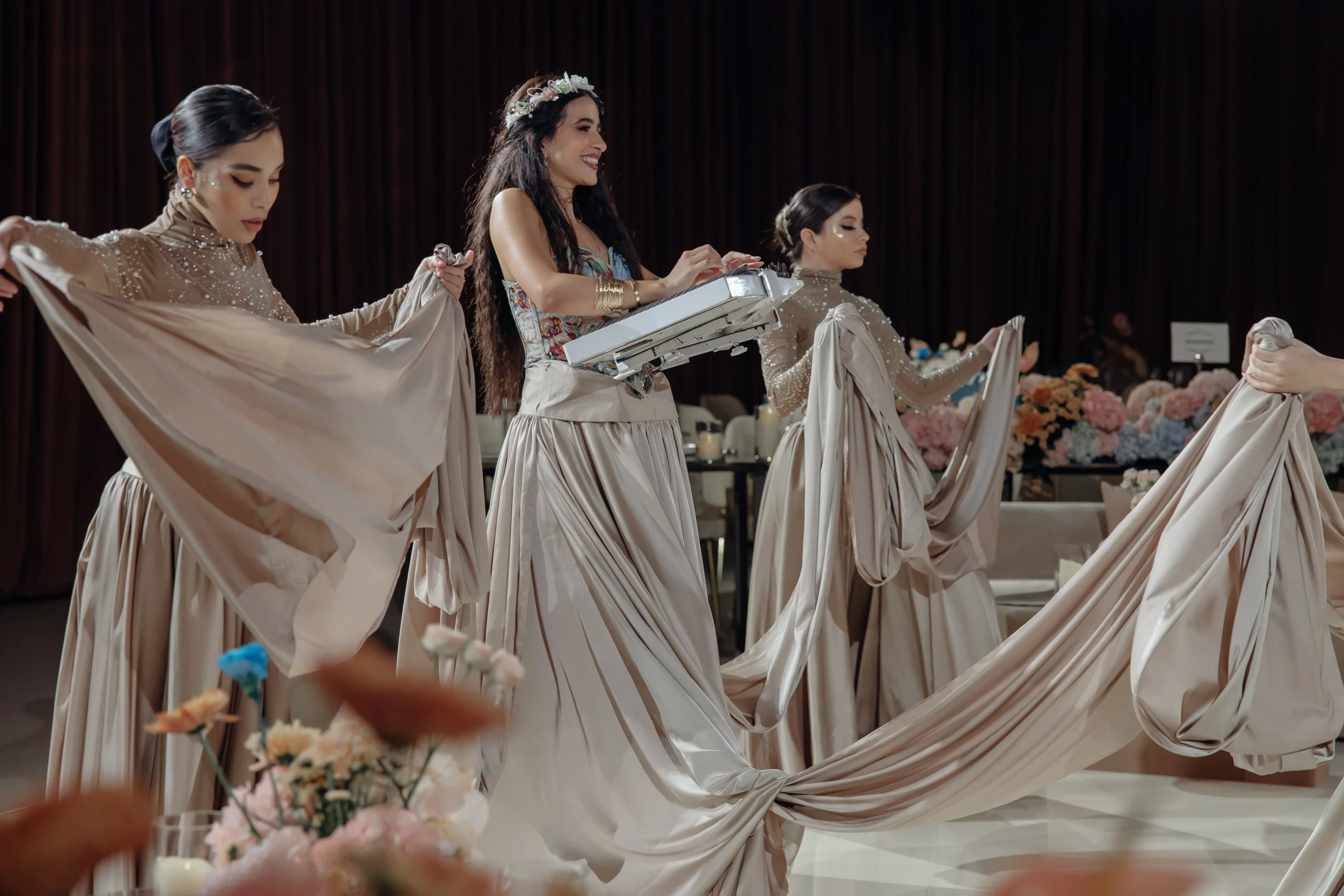
One of the clearest examples of that is her Flying Qanun show, a concept that sounds theatrical because it is. Debal says she became “the first female artist to perform while moving with the instrument.” That in itself would have been enough to draw attention, but what is more interesting is the amount of thought behind it. The performance was not treated as a stunt. It was treated as a composition in itself.
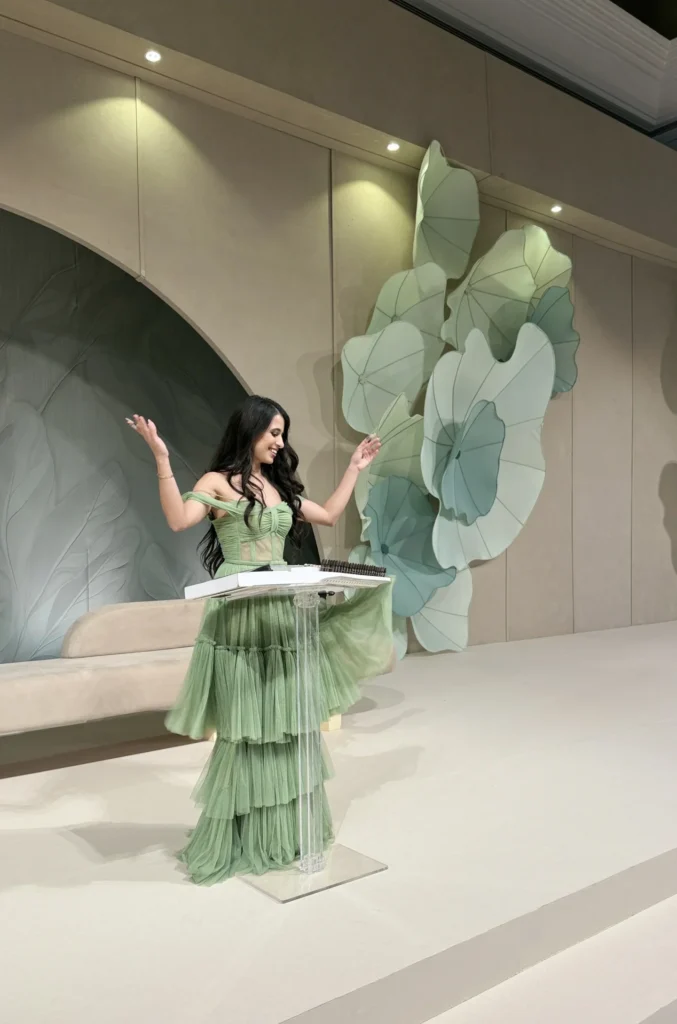
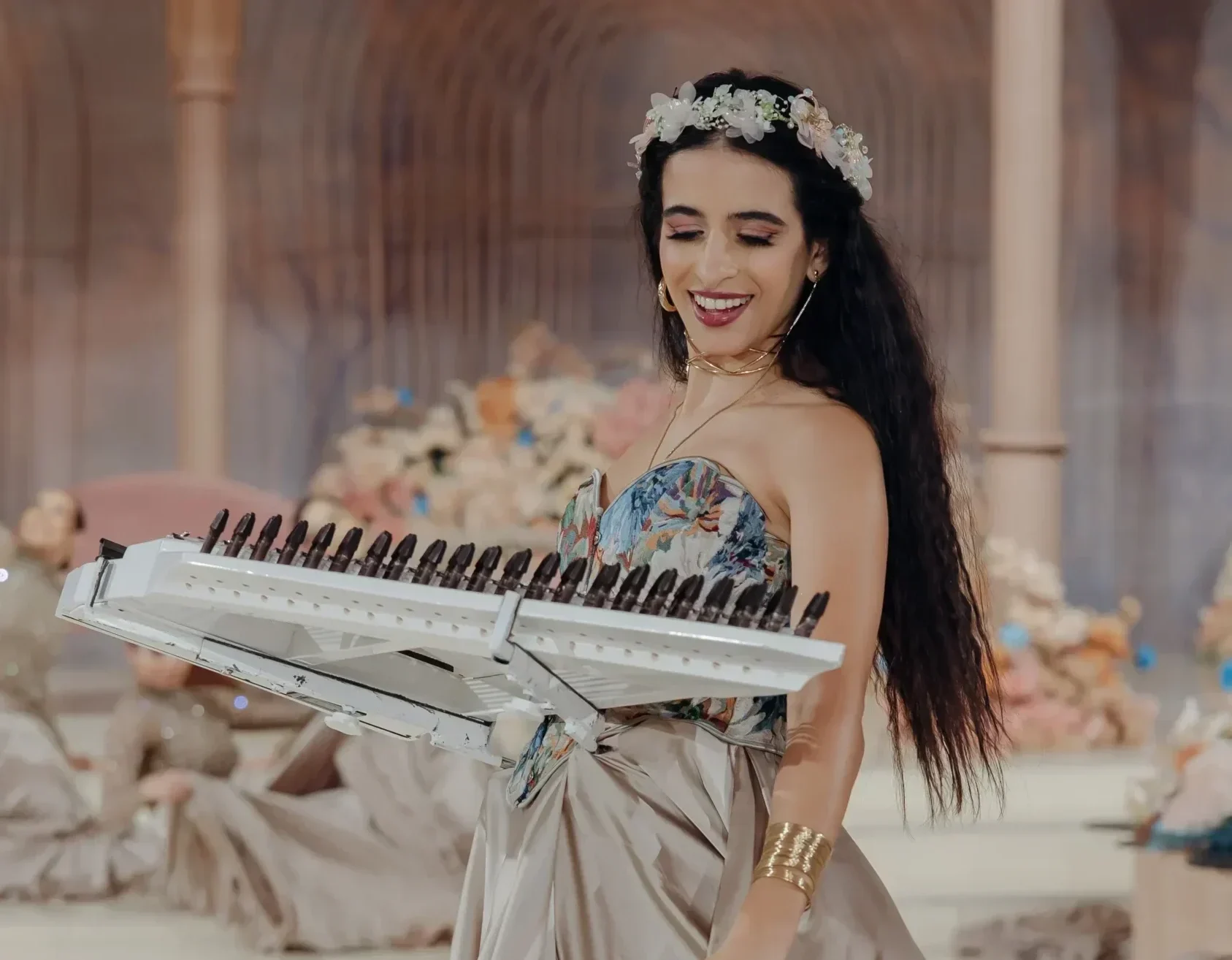
“This required designing a custom qanun that is both practical and elegant,” she explains. She also created a transparent stand and curated her own dresses for each performance. “Every detail, from visual identity to performance, was carefully crafted to create a complete experience.”
That sentence says a great deal about how she works. The music is central, but the image is not an afterthought. In today’s performance culture, where audiences consume art with their eyes as much as their ears, presentation matters. Debal seems to understand that instinctively. Yet she uses presentation in service of the music, not instead of it.
That is why her performances do not read like costume pieces or branding exercises. They feel considered. The transparency of the stand, the movement, the clothes, the smile she mentions so plainly, all of it appears to be part of one coherent idea: that an artist should not arrive fragmented. “What truly defines me is authenticity,” she says. “My smile on stage is always a genuine reflection of my connection with the audience.”
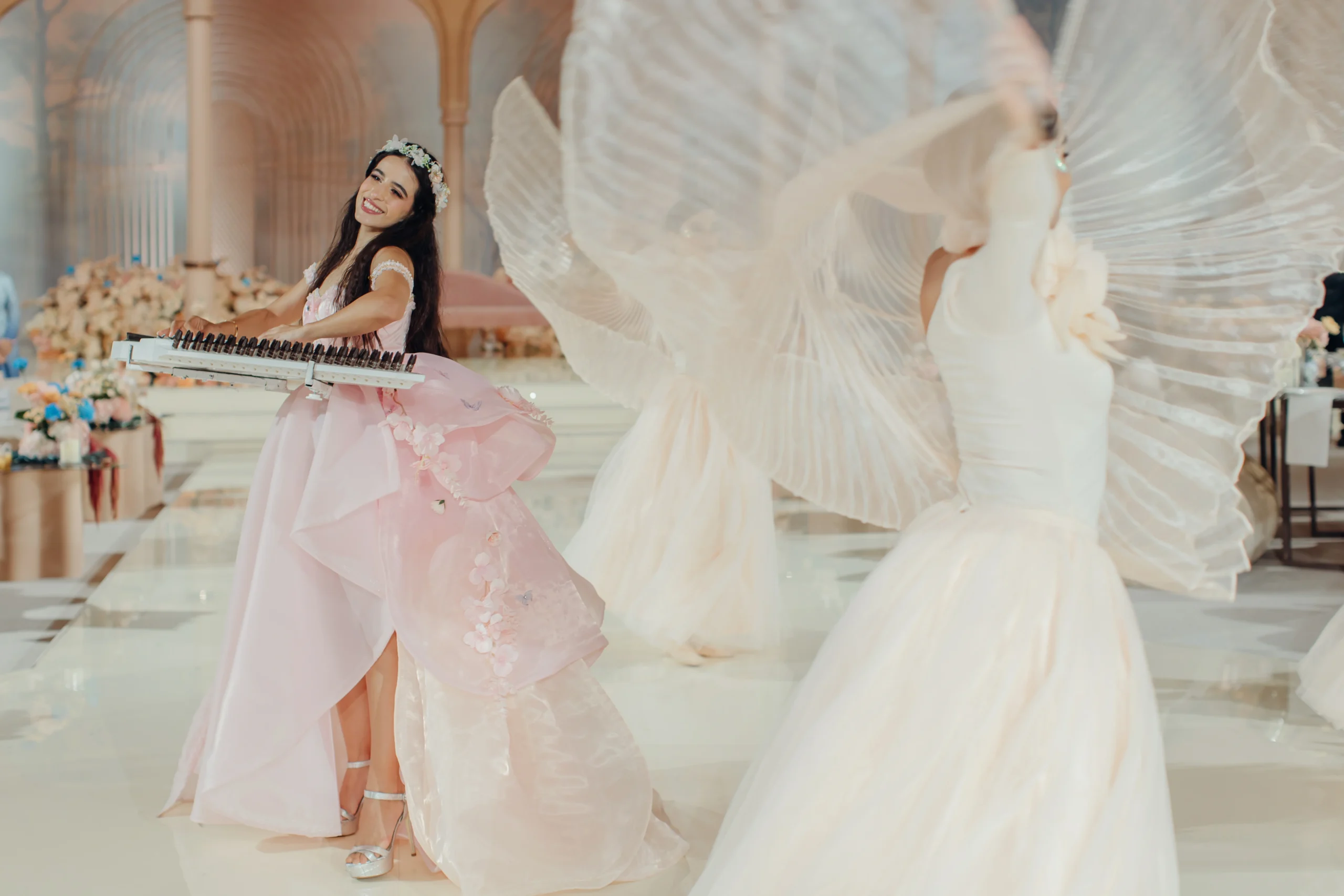
The line is simple, but it explains a lot. In a field where many performers are urged to manufacture personality, Debal appears committed to something less performative and more durable. Her presence on stage is not a mask. It is a continuation of her own temperament. That matters because audiences can usually tell the difference.
She has performed on major platforms, including the Dome of Dubai Expo 2020, the Dubai Shopping Festival, the World Government Summit, and other VIP events. These are not small rooms with forgiving audiences. They are environments where the artist must read the mood quickly and respond without losing herself. Debal seems to see that as part of the job. “Every audience has its own energy,” she says. “Some performances require high energy, while others focus on emotion and subtlety.”
That flexibility is one of the reasons her work translates across settings. She does not force one emotional register onto every room. Instead, she listens first and then shapes the performance to fit. “Adaptability is key,” she says, “while staying true to my artistic identity.”
Dubai, she adds, has widened her perspective. “It has expanded my perspective,” she says of the city’s diverse audiences. And that insight is easy to understand. In a place where people arrive from everywhere, the idea of making music that connects beyond language is not just desirable. It is necessary.
“I aim to create music that feels universal, something that anyone, regardless of background, can connect with emotionally,” she says.
That is a difficult standard, and one that many artists talk about but fewer actually meet. Debal’s answer suggests that she is not chasing universality by flattening the work. She is trying to reach it through feeling. That distinction matters. A piece of music does not need to be culturally empty to be widely felt. In fact, the opposite is often true. The more honestly it carries its roots, the more likely it is to reach people beyond them.
Her work through Debal Events extends that same thinking into the business of creating opportunities. She describes the venture as a family effort, and that family connection seems to give the work an unusual steadiness. “Creativity thrives in a supportive environment,” she says. “Working with my family brings trust and harmony into my work.”
Through Debal Events, she and her family have built a platform that supports artists in the UAE by giving them access to major events and brand collaborations. That role may be less visible than her performance work, but it is no less important. The regional music industry, like many creative industries, often depends on who can open a door and who cannot.
Platforms like this matter because they turn isolated talent into a visible opportunity.
Debal also sees mentorship as part of her responsibility, especially for women. “I am deeply committed to supporting female qanun players,” she says, “not only musically, but also in how to present themselves as complete artists.”
That phrase, “complete artists,” is telling. She is not speaking only about notes, technique, or repertoire. She is speaking about presence, conviction, and the ability to occupy a space without apology. In an industry where women are still too often evaluated more harshly on image than skill, that kind of mentorship can be decisive.
Her advice to younger artists is direct. “Understand your roots first,” she says. “A strong foundation allows you to evolve without losing direction.” She adds, “Don’t be afraid to be unique, the world values originality. The true strength lies in blending heritage with modernity.”
It is easy to hear those lines as advice, but they also read like a description of her own practice. She has not built her career by chasing novelty for its own sake. She has built it by insisting that the past can still produce new forms, new meanings, and new audiences when handled with care.
Her view of the future of Arabic music is similarly clear-eyed. She believes it has “strong potential to reach global audiences more than ever before,” but she is realistic about what is required. “It needs to be presented in a modern and accessible way,” she says.
That does not mean watering it down. It means finding forms that can travel without distortion. It means understanding that global reach is not achieved by abandoning identity, but by sharpening it.
“My goal is to be part of this movement,” Debal says, “representing our culture while sharing its essence with the world.”
That may be the most accurate way to describe her place in the current moment. She is not trying to turn the qanun into something it is not. She is showing that it can still surprise people, still move across stages, still speak to new audiences without surrendering its soul. In a city like Dubai, that kind of work feels especially fitting. The city is built on arrival, but it is also built on reinvention. Debal understands both.
She has found a way to stand inside her heritage without freezing it, and to move toward modernity without rushing past its roots. In that sense, her music reflects the city that shaped her: layered, multilingual, and always in motion. But unlike the city, she is not trying to be everywhere at once. She is doing something rarer. She is making sure the sound stays true while the stage keeps changing.