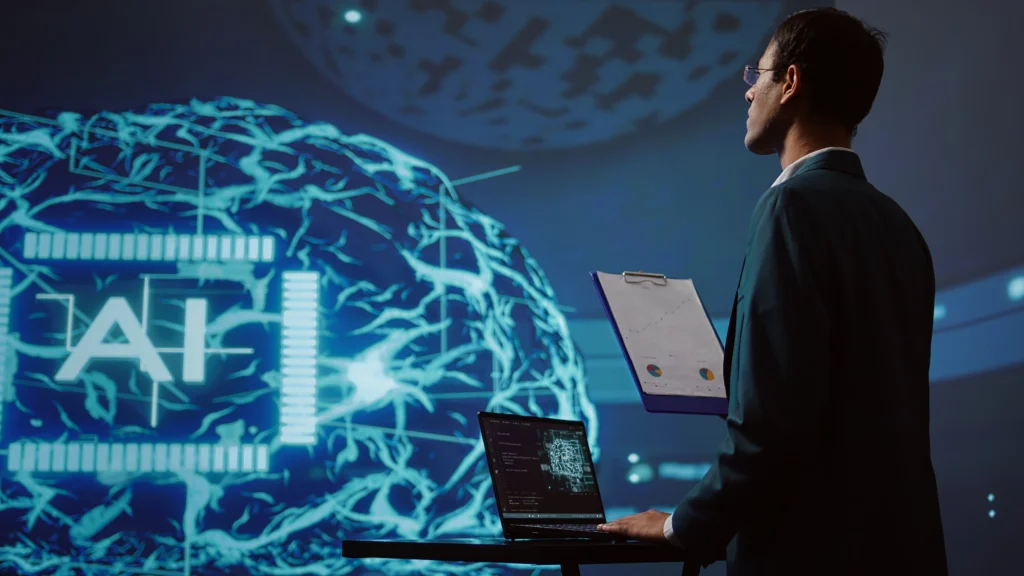
Artificial Intelligence and the Future of Decision-Making
How AI is transforming the way people and organisations analyse information, solve complex problems and make better choices
By Marina Ezzat Alfred

Every day, people make hundreds of decisions, often without even realising it. Some are simple, such as choosing the quickest route to work or deciding what to watch after dinner. Others carry far greater consequences, including making medical diagnoses, approving business investments or developing government policies.
As the amount of information available continues to grow, making well-informed decisions has become more challenging than ever. This is where artificial intelligence (AI) is making a significant difference. Rather than simply replacing human thinking, AI is increasingly being used to help people make faster, more informed and more effective decisions by turning vast amounts of data into meaningful insights.
As the technology continues to develop, it is changing not only how decisions are made, but also how individuals and organisations approach complex problems across almost every industry.
Artificial intelligence enables computers to analyse information, recognise patterns and learn from data in ways that were once considered possible only through human effort. Instead of spending hours reviewing reports or comparing thousands of data points, AI can process information within seconds and identify the details that may matter most.
However, AI should not be viewed as a replacement for human intelligence. It is better understood as a powerful tool that supports decision-makers by providing recommendations based on data and evidence. Human judgement remains essential because many decisions involve emotions, ethics, creativity and personal values that machines cannot fully understand.
The most effective decisions often come from combining the speed and analytical capabilities of AI with human experience, intuition and judgement.

Modern businesses generate enormous amounts of information every day. Customer purchases, website visits, social media interactions, financial reports and supply chain operations all produce valuable data. The challenge is no longer simply collecting information, but understanding what it means and turning it into useful action.
AI helps businesses make sense of this information by identifying patterns that might be difficult for people to detect independently. A retailer, for example, can use AI to predict which products customers are most likely to purchase during a particular season. A manufacturing company can identify equipment that may require maintenance before a breakdown occurs. Marketing teams can analyse customer preferences and develop more personalised campaigns designed to improve engagement.
These insights allow organisations to make decisions based on evidence rather than assumptions. Instead of waiting for problems to occur, businesses can anticipate changes, reduce risks and respond more confidently to emerging opportunities.
Healthcare is another area where artificial intelligence has the potential to make a significant difference. Doctors and healthcare professionals regularly need to evaluate large amounts of patient information while making decisions that can have life-changing consequences. Reviewing medical histories, laboratory results, imaging scans and medical research can be time-consuming.
AI can help by analysing this information quickly and identifying patterns that may indicate particular diseases or health risks. In some circumstances, AI systems can identify abnormalities in medical images and provide clinicians with additional information to support their assessments. AI can also help identify potential treatment options by analysing similar cases and relevant medical research.
Even with these advances, technology does not replace healthcare professionals. Patients still need doctors and nurses who can explain treatment options, provide emotional support and consider personal circumstances that an algorithm cannot fully understand.

Travel becomes not only about indulgence and escape but also about connection, contribution, and responsibility. In this new
AI is best viewed as an additional tool that can support healthcare professionals and potentially help them make more informed decisions.
Financial decision-making is also being transformed by artificial intelligence. Whether approving loans, detecting fraudulent transactions or analysing investment opportunities, financial institutions need to process large amounts of information accurately and efficiently.
Banks can use AI to monitor transactions continuously and identify unusual activity that may indicate fraud. Investment firms can use predictive models to analyse market trends and assess potential opportunities, while insurance companies can apply AI to evaluate risk and improve claims processing.
For customers, these technologies can lead to faster services, more personalised financial products and stronger protection against fraud. Behind the scenes, AI can support financial professionals by improving efficiency, identifying patterns and reducing the likelihood of costly mistakes.
Government is another area where AI could play an increasingly important role. Public authorities face complex challenges involving transportation, education, healthcare, public safety and environmental protection. At the same time, they must make decisions that affect thousands or even millions of people while working with limited resources.
Artificial intelligence can help policymakers analyse large datasets that might otherwise take considerable time to review. By identifying trends and modelling possible outcomes, AI can support decisions relating to infrastructure planning, emergency response, traffic management and public health.
However, when AI is used in decisions that affect citizens, transparency and accountability become particularly important. Human oversight is essential to ensure that decisions are fair, responsible and consistent with ethical standards.
Artificial intelligence is not limited to workplaces and public institutions. Many people already interact with AI every day without necessarily realising it. When a streaming service recommends a film, a navigation app suggests a faster route or an online retailer recommends a product, AI is often working quietly in the background.
These personalised experiences can save time and make everyday decision-making easier. Instead of searching through thousands of possibilities, people are presented with recommendations that are more likely to match their interests and preferences.
However, greater personalisation also raises questions about privacy. Recommendation systems often rely on personal data, making responsible data collection, strong security and greater user control increasingly important as AI becomes more integrated into everyday life.
One of the most promising capabilities of artificial intelligence is its ability to support predictive decision-making. Rather than simply analysing what has already happened, AI can identify patterns that may help organisations anticipate what could happen next.
Businesses can forecast customer demand before seasonal changes occur. Hospitals can identify patients who may require additional attention before their conditions become more serious. Manufacturers can anticipate equipment failures before they disrupt production.
These predictive capabilities allow organisations to prepare rather than simply react. Although AI predictions are never guaranteed to be correct, they can provide decision-makers with valuable information that helps them consider different possibilities and respond more effectively when circumstances change.
Despite its potential, artificial intelligence also presents challenges that cannot be ignored. One of the most significant is bias. Because AI systems learn from existing data, they can sometimes reproduce or reinforce inequalities contained within that data. If the information used to train a system is incomplete, unbalanced or unfair, the resulting recommendations may also be problematic.
This makes it essential for organisations to monitor AI systems carefully, evaluate their performance and ensure that appropriate safeguards are in place.
Transparency is another important concern. In some cases, AI systems can produce recommendations without making it clear how they reached a particular conclusion. This can make people reluctant to trust AI when decisions involve areas such as healthcare, finance or law.
Developing systems that can provide clearer explanations of their reasoning will therefore remain an important part of the future of artificial intelligence.
Privacy is equally important. AI systems often depend on access to large amounts of information, some of which may be personal, sensitive or confidential. Protecting this information through strong cybersecurity, responsible data practices and clear governance will be essential as AI becomes more widespread.
Perhaps the biggest misconception about artificial intelligence is that it will eventually replace human decision-makers entirely. The future is more likely to involve collaboration than competition.
AI is exceptionally effective at analysing large datasets, recognising patterns and identifying trends. Humans bring qualities such as creativity, empathy, ethical judgement, leadership and the ability to understand complex social and personal contexts.
These strengths complement one another.
When people and AI work together, technology can provide the analysis and information needed to understand a situation, while humans apply experience, judgement and values to determine the most appropriate course of action.
Artificial intelligence is already changing decision-making across business, healthcare, finance, government and everyday life. By transforming vast amounts of information into useful insights, AI can help people and organisations make faster, smarter and more informed choices.
Yet the real value of AI does not necessarily lie in replacing human judgement. Its greatest potential may be in strengthening it.
The future of decision-making will therefore not simply belong to machines or humans. It will belong to those who understand how to combine the strengths of both. As AI continues to evolve, organisations that use the technology responsibly while keeping human judgement at the centre will be better positioned to navigate complexity, manage risk and make decisions that create lasting value.
model, your vacation isn’t just a break from daily life; it’s a chance to give back to the planet while still enjoying moments of relaxation and joy.
Luxury travel, often criticized for its excess, is also undergoing a powerful transformation. The concept of eco-indulgence is redefining what it means to live the high life. Instead of reckless consumption, it’s about savoring exquisite experiences that also support the environment and local communities. Imagine soaking in a private hot tub at a mountainside villa where every product you use, from soaps to lotions, is crafted from rare herbs cultivated by local farmers who preserve the land. Or picture sailing aboard a sleek yacht where part of your booking fee goes directly toward ocean clean-up projects, not just token tree planting.
Organizations like the GreenLuxe Guide now rank hotels based on their environmental and cultural contributions, encouraging travelers to spend consciously. In this new paradigm, a gourmet steak dinner might directly support tiger conservation, while a chic mountain lodge might furnish its rooms with recycled wood and serve meals sourced entirely from nearby farms. Younger generations, especially millennials and Gen Z, are leading this shift. They are willing to pay more for luxury that feels meaningful, where every indulgence carries a sense of purpose. Brands like PureVibe Retreats are at the forefront, proving that you can dance, dine, and indulge in the world’s most beautiful locations while simultaneously being a steward of the earth.
All of these innovations, whether powered by artificial intelligence, shaped in the digital metaverse, driven by circular economies, or crafted through eco-luxury, are converging to create a travel experience that is richer, smarter, and more ethical than anything that has come before. Travel is no longer just about getting from point A to point B, or checking off a list of attractions. It’s about crafting journeys that reflect who we are, what we value, and how we want to interact with the world. The integration of technology ensures seamless convenience, while sustainability ensures we leave behind a positive impact. And through it all, the human touch remains central, reminding us that travel is ultimately about connection. with people, with places, and with ourselves.
The travel industry is standing at the threshold of an exciting new era, where imagination meets responsibility, and indulgence meets sustainability. The next time you plan a getaway, expect more than just a destination. Expect a carefully designed journey that understands you, excites you, and invites you to be part of something bigger than yourself. The future of travel is calling, and it promises to be extraordinary, a perfect blend of comfort, innovation, and care for the world we share.