
MAGNAV Emirates

Art and culture

Sara Altamimi

Sara Altamimi Weaving Heritage, Elegance, and Sustainability into the Future of Fashion

Sara Altamimi Weaving Heritage, Elegance, and Sustainability into the Future of Fashion By Jane Stevens From the heart of Abu Dhabi, Sara Altamimi is quietly reshaping what fashion can and should be. As the founder of her namesake brand, she has built a creative house rooted in responsibility, heritage, and artistry, where garments are not fleeting trends but timeless pieces that tell a story. Her collections, crafted from sustainable materials and designed with longevity in mind, are intended to endure for a lifetime while carrying the spirit of both past and future. For Sara, fashion has never been about consumption alone. From the beginning, she believed it should serve as a cultural dialogue, an exchange that honors the planet while celebrating artistry. “Sustainability is not a trend,” she often says, “it is the only way forward if fashion is to have meaning in the next century.” Drawing inspiration from the UAE, a nation that balances deep-rooted tradition with modern vision, she channels the energy of Abu Dhabi into her designs, creating garments that connect local heritage with global relevance. This philosophy has shaped not just how her pieces look, but how they are made. Respecting the environment pushes Sara to innovate, combining traditional craftsmanship with experimental textures and silhouettes that spark a dialogue between eras.  Her approach to luxury is thoughtful and deliberate: slow processes, ethical sourcing, and close collaborations with artisans. For her, true luxury is no longer defined by abundance but by the depth of respect a garment shows to culture, craft, and nature. Among her many creations, one holds a special place in her heart: a red puff-sleeve raglan shoulder coat made from 100% Italian mulesing-free wool. Beyond its striking texture and silhouette, the piece carries a personal story. Its design was inspired by one of her mother’s jackets from the 1980s, a reminder that heritage and memory can be seamlessly woven into modern design. Sara’s work is guided by research, exploration, and human connection. She spends time at fabric exhibitions around the world, meeting manufacturers and artisans, and discovering new techniques and materials. For her, transparency is as important as design; she believes people deserve to know where their clothes come from and what touches their skin. Ethics guide every step of the journey, from the initial concept to the final garment. But beyond materials and process, what Sara truly wants is for her creations to empower the wearer. To her, each garment is like a fragment of history rewritten for the future, designed to embody both elegance and responsibility. When something fits beautifully, highlights the body, and moves with ease, she believes it transforms into a lifetime treasure, not just a garment. The journey hasn’t been without its challenges. In an industry driven by speed and volume, Sara has had to resist the pressure to produce more, faster. Choosing quality over quantity requires courage and conviction, but these choices have strengthened her vision and built a community that shares her values. “Fashion must be part of the solution, not the problem,” she emphasizes, a belief that guides everything she creates. Looking ahead, Sara envisions her brand as a new kind of fashion house from the UAE, one that speaks to the world while protecting the environment and celebrating heritage. For her, the future of fashion lies in sustainability, not as a compromise, but as a form of innovation. Through her work, she hopes to prove that true progress is rooted in respect: respect for tradition, for artistry, and for the planet. Sara Altamimi’s designs are more than clothing, they are cultural statements, timeless heirlooms, and quiet rebellions against excess. In her vision, fashion’s future is not just beautiful, but meaningful.

Karak Culture

Karak Culture in the UAE A Unified Sip of Identity

Karak Culture in the UAE A Unified Sip of Identity By Ami Pandey In the heart of the UAE’s cosmopolitan cities, where glass towers and luxury lifestyles dominate, karak chai stands as a powerful cultural thread. This humble cup of spiced tea has transcended its role as a beverage to become a daily ritual, a social equaliser, and a symbol of shared identity in a diverse society. The Story Behind Karak Karak chai, derived from the Hindi and Urdu word “kadak” meaning strong, is a rich blend of black tea, milk, sugar, and aromatic spices like cardamom. Its variations can include saffron, cinnamon, or cloves. Priced accessibly between 1 to 5 dirhams per cup, karak is both comforting and convenient. Widely available at roadside kiosks and specialty cafés alike, its popularity cuts across all communities, Emirati youth, South Asian workers, executives, and tourists—who often gather in informal queues or drive-thru lines to enjoy this creamy, fragrant tea. Tradition in a Modern World Karak found its way into Emirati culture through South Asian migration during the 1960s and 70s. Since then, it has woven itself into the fabric of everyday life in the UAE. Cafés like FiLLi and Project Chaiwala have helped elevate its profile, balancing authenticity with modern branding. For many, karak is not just a drink but a small moment of pause and connection, offering familiarity amid the UAE’s rapid development. More Than a Beverage From humble roadside stalls to trendy tea lounges, karak is present everywhere its warm scent mingling with conversation and city noise. On social media, karak photos are shared widely, reflecting its cultural charm. New-age variants with rose, honey, or saffron reflect how it continues to evolve while maintaining its essential identity: a drink that’s as much about connection as it is about taste. Its modern appeal has also reached the attention of entrepreneurs and influencers, with the beverage becoming a central feature in fusion menus, artisanal tea offerings, and themed branding campaigns. Some outlets now offer karak in eco-conscious packaging or pair it with premium snacks, targeting a more lifestyle-oriented demographic. At the same time, the experience remains rooted in street-level accessibility, where community, casual interaction, and cultural appreciation intersect. In residential neighborhoods, office districts, and even luxury malls, karak stalls have become fixtures of daily life. These spaces, however modest, provide moments of connection between friends, between strangers, and between cultures. They reflect a uniquely UAE phenomenon: a fast-moving society anchored in the simplicity of shared tradition. Tea vs. Coffee UAE and Global Consumption Trends Tea holds a dominant place in the UAE’s beverage culture. As of 2025, tea accounts for 92.8% of the UAE’s hot drink spending, dwarfing coffee’s 7.2% share. Local tea consumption averages around 6.1 kilograms per person, notably higher than the global average of 4.6 kilograms. The market has been growing steadily with a compound annual growth rate of over 5% in recent years, reaching a value of $373 million in 2021. Organic tea, in particular, is gaining momentum, expected to grow by 15% annually and reach $30 million by 2030. The UAE has also emerged as a major tea exporter, with 2023 figures placing its tea exports at nearly $400 million, making it the fifth-largest in the world. Globally, tea remains a powerhouse in the beverage sector. The global tea market is valued at over $100 billion and is projected to grow at a steady rate of around 6.5% annually. Six billion cups of tea are consumed daily across the globe, with China and India producing nearly 70% of the world’s tea supply. Though coffee slightly leads in global revenue, tea surpasses coffee in daily servings and is consumed by roughly 80% of the global population, compared to 57% for coffee. Coffee is growing marginally faster in financial terms, but tea’s affordability, versatility, and health perception give it a unique edge, especially in emerging markets and health-conscious demographics. In the UAE, tea’s cultural and economic relevance continues to grow. It is both a nostalgic comfort and a modern symbol of multicultural identity. From traditional karak to premium organic blends, tea has firmly entrenched itself not only in the local lifestyle but also in the country’s international trade and hospitality sectors. The challenge for coffee to overtake tea in this region remains steep, as tea continues to define community, culture, and daily life in the Emirates. Karak is more than a drink, it is a living tradition. In a country of over 200 nationalities, it acts as a common denominator, one that requires no translation, no protocol, and no status. Whether in a sleek café or from a roadside kiosk, the karak experience is intimate, familiar, and enduring. Its legacy, built on inclusion and simplicity, positions it not just as a cultural staple but as a long-term economic opportunity in both domestic and export markets. As tea culture grows globally, the UAE’s embrace of karak may well serve as a model of how tradition can adapt, thrive, and unify in the modern age.

Cultural Heritage Meets Tech

Cultural Heritage Meets Tech

Cultural Heritage Meets Tech Preserving Emirati Traditions Through Innovation By Marina Ezzat Alfred In an era of rapid technological change, the preservation of cultural heritage has found a powerful ally in innovation. Nowhere is this more evident than in the United Arab Emirates. a country rich in history and tradition, yet forward-thinking in its embrace of digital solutions. From artificial intelligence to augmented reality and digital storytelling, the UAE is leading a cultural renaissance that safeguards Emirati identity while engaging new generations in meaningful and modern ways. Emirati culture is deeply rooted in Bedouin traditions, Islamic values, and a legacy of exploration and trade. As globalization continues to blur cultural boundaries, the urgency to preserve these unique traditions has grown. Integrating technology into this mission isn’t just an enhancement, it’s a necessity. Artificial intelligence is transforming how we interact with heritage. In museums across the UAE, AI-powered tools are creating personalized visitor experiences, such as chatbots that offer guided tours and respond to inquiries in real time. Beyond enhancing exhibitions, AI analyzes vast datasets on historical artifacts, uncovering patterns that provide new insights for historians and researchers. These tools are uncovering connections and narratives that may have otherwise been lost. Digitization is another critical advancement. Through AI, fragile manuscripts, photographs, and objects are being meticulously preserved, making them accessible to global audiences. This not only protects them from physical deterioration but also democratizes access to knowledge ensuring that Emirati history is available to all, regardless of location. Additionally, machine learning technologies are being used to guide the restoration of damaged artifacts, helping conservators make informed decisions while preserving the integrity of the original work. Augmented reality (AR) further bridges the gap between past and present. In institutions like the Louvre Abu Dhabi, AR enables visitors to immerse themselves in historical scenes, gaining deeper context and emotional connection to the displays. Outside museum walls, AR is enhancing educational experiences in schools and universities, allowing students to virtually explore heritage sites and traditional artifacts. This immersive approach not only makes learning more dynamic but also instills a sense of pride and identity in young Emiratis. AR’s reach extends beyond local education. Tourists visiting the UAE can now use AR apps to engage with Emirati traditions in interactive, visually rich ways. This kind of cultural exchange fosters global understanding and appreciation, highlighting the UAE’s role as a hub where heritage and innovation coexist. Digital storytelling has also emerged as a powerful medium for cultural preservation. Across the country, creative projects are capturing the personal stories of Emirati families, artisans, and community leaders. These narratives, told through videos, podcasts, and interactive online platforms, document lived experiences, crafts, customs, and values. They reflect a shared memory that evolves over time but remains deeply rooted in tradition. Social media platforms have become an unexpected yet vital space for this storytelling. Emiratis are sharing everything from family recipes to traditional dance performances on Instagram and TikTok, connecting with audiences in real-time and across borders. These grassroots efforts are keeping cultural practices alive and relevant, especially among the younger generation. Yet, this digital revolution is not without challenges. As technology enables wide dissemination of cultural content, there is a risk of misrepresentation. Ensuring authenticity and accuracy is critical, especially when traditions are translated into digital formats. Moreover, equitable access to these technologies remains a concern. Not everyone has the same resources or connectivity, so inclusive policies must be implemented to ensure all communities can participate in and benefit from digital heritage initiatives. Looking ahead, the fusion of technology and tradition offers an inspiring path forward. The UAE’s commitment to using innovation to protect its cultural roots is both a celebration of the past and a vision for the future. AI, AR, and digital media are not just tools—they are bridges that connect generations and cultures. As these technologies continue to evolve, they will offer even more opportunities to engage with heritage in ways that are authentic, inclusive, and inspiring. For the Emirati people, and for the world, this is a testament to the power of tradition and the boundless potential of human creativity.

Emirati Artists Are Programming

How Emirati Artists Are Programming the Nation’s Next Heritage

How Emirati Artists Are Programming the Nation’s Next Heritage By Hafsa Qadeer Art, in the UAE, no longer sits solely on canvas or stone. It pulses through LED walls, whispers in algorithms, and lives in the invisible syntax of code. In a land where museums rise beside mosques and data centers hum beneath heritage sites, a new generation of Emirati creatives is forging a future where tradition is not archived, but reprogrammed. This is not a rebellion against heritage. It is a redesign. Culture, in their hands, becomes a living codebase, continuously compiled across mediums, minds, and machines. The Digital Majlis Where elders once gathered beneath tents to share poems, today’s artists meet inside digital forums and NFT galleries. The majlis has migrated to the metaverse. Here, traditional Nabati poetry is visualized through VR. Calligraphy curves into 3D animations. Music composed with oud and AI-generated beats streams through headphones in global cities. Yet the soul remains Emirati. Artists like Maitha Al Khayat and Ammar Al Attar use augmented reality to revive ancestral crafts. AI artists remix archival photos with machine learning to create speculative histories. The past is not lost, it is remixed, rendered, and reintroduced. Museums Without Walls Culture in the UAE no longer needs walls to be displayed. It lives on screens, in apps, and on-chain. The House of Wisdom in Sharjah offers immersive installations where books talk back. Alserkal Avenue hosts exhibitions that blur art and interface. Louvre Abu Dhabi’s digital twin allows global access to Emirati heritage. In this shift, the definition of art expands. A line of code becomes calligraphy. A blockchain ledger becomes a registry of oral histories. A data visualization of desert winds becomes poetry in motion. This is not just digitization, it is a new dialect of tradition. Heritage Hackers and Cultural Coders These creators are not just artists. They are cultural coders, writing scripts that preserve identity in languages the world can now understand. Their studios look more like labs. Their canvases are sometimes touchscreens. Yet their work holds the same intent: to remember, to reflect, and to reshape. Projects like the UAE National Archives’ AI oral history translators, or the Ministry of Culture’s blockchain art certification initiative, point to a state-sponsored belief: that the future of heritage depends on innovation. Even the oldest stories must sometimes wear new skins. When AI Learns Our Stories Perhaps the most profound shift is not just in the tools but in the tutors. Emiratis are now teaching artificial intelligence to speak their culture. From training large language models in Arabic dialects to inputting Emirati metaphors into generative systems, this is more than technical, it’s philosophical. What should a machine know about a people?  How can a dataset carry the scent of oud, the weight of ghutra, the silence of a desert dawn? In the UAE, these questions are not theoretical. They are the foundation of a new creative movement: one where machines become memory-keepers, and where Emirati culture evolves, not in opposition to tech, but through it. A Nation Written in Light and Language Art here does not choose between fiber and fiber-optic. It chooses both. Because in the UAE, technology is not erased. It is illumination. And the artists who move between realms, tradition and innovation, camel hair and code, are not bridging a gap. They are building a bridge. A bridge to a culture that never stays still.  A bridge to memory that you can scroll, remix, and still feel in your bones.  A bridge to a future that remembers where it came from. And on this bridge, the UAE walks forward, poet, programmer, and preservationist, all at once.  

Emirati Visions in Focus

Emirati Visions in Focus

Emirati Visions in Focus By Hafsa Qadeer The 2025 Alserkal Avenue Art Week in Dubai’s Al Quoz district has spotlighted Emirati photography, with Khalid Al Shamsi’s Urban Mirage series capturing the nation’s essence. His images juxtapose the Burj Khalifa’s sleek lines against swirling Bedouin patterns, using long-exposure techniques to reflect the UAE’s rapid evolution rooted in tradition. The series, displayed in Alserkal’s minimalist galleries, portrays the Emirates’ skyline as a dialogue between past and future, drawing crowds from across the region. This celebration of local talent underscores Dubai’s growing status as a global art hub. Sharjah’s art scene is equally vibrant, with the Sharjah Art Foundation’s Focus Emirates initiative showcasing young photographers exploring identity and sustainability. Their works, from Kalba’s shimmering mangroves to Deira’s bustling souks, are exhibited in pop-up galleries, attracting international collectors. The initiative highlights the UAE’s commitment to fostering creativity that bridges heritage and modernity. As these artists gain global recognition, their photographs offer a fresh lens on the Emirates, revealing a nation that thrives on its cultural depth and forward-thinking vision.

Sonic Ecology

How Sonic Ecology Is Shaping UAE’s New Art Frontier

How Sonic Ecology Is Shaping UAE’s New Art Frontier By Hafsa Qadeer The desert is not silent. It breathes, it echoes, it hums beneath the surface. And now, artists in the UAE are turning that elusive music into a new form of expression: sonic ecology. Across the dunes of Liwa and the mangroves of Jubail, sound artists are capturing the invisible pulse of nature, birdsong, sandstorms, camel herds, even seismic vibrations, and transforming them into immersive installations and digital compositions. These aren’t field recordings. They are rituals of deep listening. Sound, here, becomes memory. At NYU Abu Dhabi, an emerging discipline has taken root: acoustic ecology fused with Gulf heritage. Scholars and artists collaborate to preserve fading sonic landscapes, like the distinct rhythm of pearl divers’ chants or the hollow resonance of traditional dhow-building yards. The aim is not nostalgia, but relevance. What does it mean to map the spirit of a place through its sound? In the new Saadiyat sound dome, visitors lie beneath an aurora of speakers projecting layered desert audio. A falcon’s cry morphs into oud strings. The wind becomes a tempo. In this chamber, the environment is composed, and the audience is the instrument. This is more than an art movement. It’s a form of climate awareness. By rendering ecological shifts audible, sonic artists invite listeners to feel environmental loss, not in charts, but in silence. One installation lets you hear the difference between coral reefs today and twenty years ago. The gap between those recordings is a quiet that screams. Artists are also creating “bio scores”, soundtracks generated from live data, like mangrove growth rates or camel migration patterns. These scores are performed live, turning scientific data into emotional resonance. The language is universal. You don’t need to understand the Gulf dialects to hear what’s being lost, or found. From Fujairah’s coastal caves to Dubai’s hyper-modern rooftops, microphones are being planted like seeds. The new galleries aren’t always visual; they’re audible. And often, they’re mobile. A new generation of UAE creatives is choosing not to paint or sculpt, but to listen, and to translate. They’re not just capturing what the desert sounds like. They’re asking what it wants to say. And we are beginning to hear it.

The Spirit of the Union

The spirit of the Union How the UAE Became a Beacon of Unity & Safety

The Spirit of the Union: How the UAE Became a Beacon of Unity, Safety, and Global Progress By Ami Pandey In a land once marked by vast deserts and ancient trade routes, something extraordinary took root, a shared dream that transformed the United Arab Emirates into a global success story. On December 2, 1971, seven emirates, Abu Dhabi, Dubai, Sharjah, Ajman, Umm Al Quwain, Fujairah, and later Ras Al Khaimah, chose unity over division. But what they built wasn’t just a federation. They created a future. At the heart of this future lies a deep, enduring idea: the Spirit of the Union. More Than a Motto: The Meaning Behind the Spirit The Spirit of the Union is not a phrase for display, it’s the invisible thread that binds the country together. It speaks of shared ambition, collective resilience, and a vision rooted in both heritage and innovation. It’s what allows people from every walk of life, citizens and expatriates alike, to feel part of something greater. This spirit fuels a society where progress doesn’t erase culture, where dreams are encouraged, and where every success is built on collaboration. Tradition and Tomorrow: Finding the Balance While the UAE is often portrayed through its glittering skyline and luxurious lifestyle, these are just glimpses of a deeper story. The true essence of the UAE lies in its ability to honor the past while embracing the future. Emirati culture remains alive in everyday life, majlis gatherings, falconry, pearl diving stories, and the rhythmic steps of the Al Ayala dance continue to thrive. In shopping malls, you’ll find traditional kanduras and abayas side by side with global fashion brands. The scent of oud, the rhythmic call to prayer, and family-centered traditions all coexist with cutting-edge technology and modern infrastructure. What makes this more remarkable is how the UAE has become a home for more than 200 nationalities, all coexisting peacefully. The result is a unique cultural harmony—where diversity is not just tolerated but celebrated. Leadership with Vision: The UAE’s Guiding Force The transformation of the UAE from desert towns to a global hub wasn’t coincidence, it was leadership with clarity and purpose. The late Sheikh Zayed bin Sultan Al Nahyan, the founding father, laid the foundation for a nation driven by unity, generosity, and opportunity. Today’s leaders carry that legacy forward through bold strategies in space exploration, renewable energy, AI, and economic diversification. National blueprints like UAE Vision 2031 and Centennial 2071 are not just government targets, they are ambitious roadmaps shaping every aspect of the country’s future, from education to sustainability. A Nation Built on Peace and Safety Ask anyone living in or visiting the UAE, and you’ll hear a consistent truth: the UAE is one of the safest countries in the world. This is not just a statistical achievement, it’s a daily reality. Low crime rates, effective law enforcement, community engagement, and state-of-the-art surveillance all contribute to a sense of comfort and security that is rare globally. Women’s safety, in particular, stands out, many women in Abu Dhabi, Dubai, and other emirates report feeling safer here than in some of the world’s most developed cities. The government’s unwavering stance against extremism, discrimination, and violence helps ensure this level of peace and social stability. The UAE Passport: A Badge of Global Trust Once overlooked, the UAE passport is now among the most powerful in the world, offering visa-free or visa-on-arrival access to over 180 countries. This wasn’t achieved through historical dominance, it was earned through diplomacy, neutrality, and bridge-building. The UAE has positioned itself as a global peacemaker, actively engaging in humanitarian efforts and fostering international partnerships. By staying above political conflicts and focusing on positive contributions, the UAE has become a trusted global player, respected not for its size, but for its intent and integrity. Lessons for the World: A Blueprint for Modern Nationhood The UAE’s journey is more than a national narrative, it’s a living example of what visionary governance, cultural respect, and collective ambition can achieve. Here are just a few lessons the world can take from the Spirit of the Union: Unity doesn’t mean losing cultural identity Progress can coexist with humility Safety and peace are achievable with purpose-driven leadership Diversity is a strength when guided by mutual respect The Desert That Dreamed Big At its core, the UAE’s story is about possibility. About what happens when a country dares to dream big, when its people unite for a purpose, and when tradition is used not as an anchor, but as a compass. The Spirit of the Union is not just for Emiratis, it’s a global message. A reminder that with courage, leadership, and unity, even the sands of the desert can bloom into something extraordinary.

The Rise of Computational Calligraphy in the Gulf

The Rise of Computational Calligraphy in the Gulf

Sand Algorithms The Rise of Computational Calligraphy in the Gulf By Hafsa Qadeer What happens when a centuries-old script meets machine learning? In the UAE, the result is a breathtaking collision of tradition and technology, computational calligraphy. It is not a trend. It is a revelation. Emerging from innovation labs in Sharjah and artist collectives in Abu Dhabi, computational calligraphy fuses Arabic calligraphy with generative design, AI algorithms, and kinetic sculpture. These aren’t digital fonts, they are living, moving systems that write, reinterpret, and evolve classical forms in real time. Here, heritage is not archived; it is coded. At the heart of this movement is a desire to preserve the sacred geometry of Arabic script while pushing its aesthetic into unexplored dimensions. Calligraphers work not with ink and reed, but with styluses, neural networks, and parametric design tools. Their screens become scrolls. Their outputs, a dance between intention and algorithm. One artist, for instance, teaches a machine the stroke logic of Ibn Muqlah’s proportional script. The result? Endless iterations of form, never identical, always in dialogue with the original. The machine becomes a student. The calligrapher becomes a conductor. This revolution is deeply local. In Sharjah’s House of Wisdom, visitors now witness robotic arms writing verses from pre-Islamic odes, choreographed with the precision of a dancer. At Dubai’s Alserkal Avenue, immersive exhibits let audiences step into generative script environments, where letters bloom around them like vines, responsive to voice, motion, even emotion. It’s not just visual. It’s experiential. But it is not without reverence. These innovators are not distorting legacy, they are protecting it from digital extinction. Many classical calligraphic styles, once confined to manuscripts, now find new life in 3D printing, projection mapping, and AR. With every pixel, the soul of the script is safeguarded. Beyond galleries, computational calligraphy has reached education and therapy. Children with disabilities use voice-activated systems to write their names in Diwani script. Elderly citizens use AI styluses to practice traditional penmanship, even as age blurs their grip. Code becomes a conduit. This isn’t the death of the handwritten. It is its resurrection. In a time when culture risks flattening into trend cycles, the UAE’s artists are creating deep continuity. They’re not just teaching machines to write. They are teaching them to remember. The art is still sacred. Only the tools have changed.

Harmony in Contrast: The UAE’s Timeless Dance Between Tradition and Tomorrow

The UAE Timeless Dance Between Tradition and Tomorrow

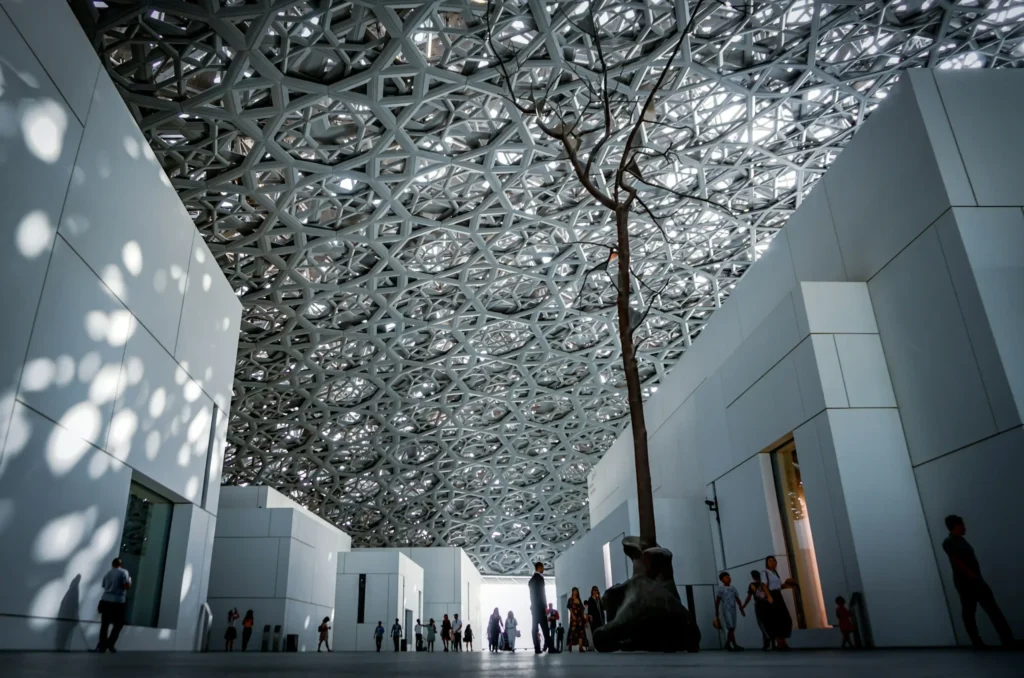
Harmony in Contrast The UAE Timeless Dance Between Tradition and Tomorrow By Hafsa Qadeer There is a quiet poetry to life in the UAE. It is a place where the call to prayer coexists with the hum of electric cars, where falcons soar above futuristic skylines, and where the ancient rhythm of the desert meets the pulse of global ambition. Few nations in the world master the art of contrast like the United Arab Emirates. It is not just a juxtaposition of old and new. It is a carefully choreographed harmony between them. Across its seven emirates, time does not divide traditions and trends. Instead, it layers them, creating a cultural rhythm that is entirely its own. Cities Built on Duality Stroll through downtown Dubai and you might pass a luxury fashion house followed by a souk selling spices in woven baskets. Look closer, and you will see that both are equally part of the story. Both curated. Both celebrated. In Abu Dhabi, the domes of the Sheikh Zayed Grand Mosque reflect the same sunlight that catches on the curved glass of the Louvre. One speaks of faith. The other of art. Together, they whisper of a people rooted in heritage and fearless in their vision of tomorrow. A Landscape That Teaches Stillness Yet the UAE is more than its cityscapes. Head into the desert and everything changes. The pace slows. The horizon widens. In places like Liwa and the Empty Quarter, silence is not emptiness. It is present. Bedouin life still echoes here, not as a museum piece, but as a living tradition. You see it in the way tea is poured, how the wind is read, and how stories are told by firelight. Even here, modernity arrives gently. Eco-resorts powered by solar energy, digital nomads working under canvas roofs, drone shows painting the stars. The past is not erased. It is expanded. A Culture of Balance What sets the UAE apart is not the scale of its achievements, but the soul behind them. The balance between ambition and preservation is no accident. National identity is taught early through poetry, storytelling, and family. Children grow up celebrating Flag Day and planting mangroves. Heritage villages are not tourist attractions but classrooms. Emirati designers are creating global labels that honor local fabrics and patterns. This is not nostalgia. It is pride. Women at the Crossroads Perhaps nowhere is this harmony more visible than in the evolving role of women. Emirati women today are pilots, ministers, and CEOs, but also keepers of oral history, cuisine, and customs. They walk in both worlds with confidence. A female calligrapher in Sharjah blends ancient scripture with modern design. A perfume maker in Al Ain bottles scents passed down by her grandmother. In the UAE, tradition is not a boundary. It is a foundation. Why Contrast is the Future As many countries grapple with identity in an age of globalization, the UAE offers a compelling answer. Contrast is not conflict. It is creativity. By embracing paradox, the nation has carved a unique voice on the global stage. It does not have to choose between the camel and the hypercar, the abaya and the Met Gala, the falaj and the fiber-optic. It can hold them all. A Living Metaphor The UAE is, in essence, a living metaphor for the modern human experience. We too live between screens and stillness, between belonging and becoming. And if we listen closely, we might find our own rhythm in the desert’s breath. In its ability to move forward without letting go. Here in the UAE, progress does not mean forgetting. It means remembering differently.