
Najla Alqahtani, The Voice Behind Saudi Football’s New Era
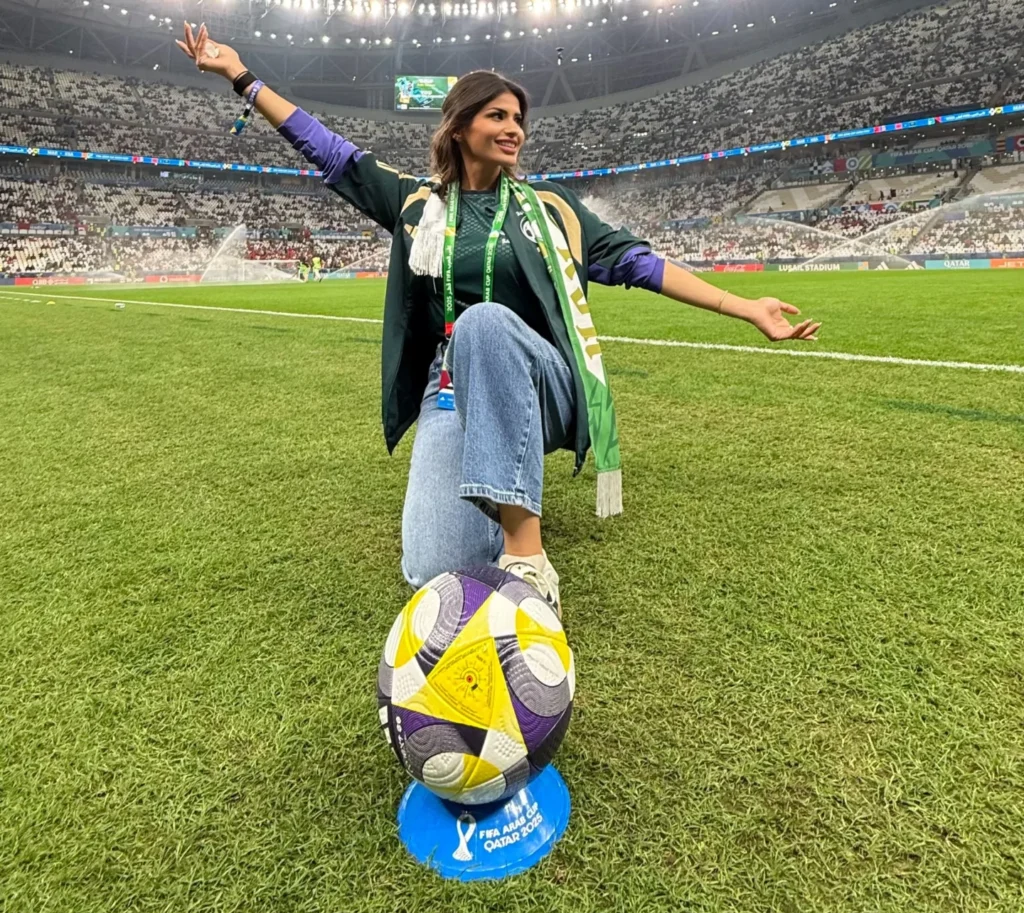
Najla Alqahtani, The Voice Behind Saudi Football’s New Era By Ami Pandey There is a moment, just before kickoff, when the stadium seems to inhale as one. The floodlights hum, the air tightens, and thousands of voices hover on the edge of eruption. In Saudi Arabia, that moment does not remain contained within the walls of a stadium. It spills outward, into homes, cafés, car rides, and endless digital threads where fans dissect, celebrate, and relive every second. Football here is not an escape from daily life; it is embedded within it, shaping emotion, conversation, and identity with remarkable intensity. For Najla Alqahtani, this reality is not an abstract cultural observation but a lived experience. It is the world she steps into, documents, and translates for a rapidly growing audience that does not simply follow the game but feels it deeply. “What has surprised me most is how deeply football is woven into everyday life in Saudi Arabia,” she says. “It’s not just a sport, it’s a shared language. One match can shape moods, conversations, and even identity. People don’t just watch football here, they live it.” Her words capture a truth that statistics often fail to express: football in the Kingdom operates as a social current, one that runs through generations and across communities, connecting people through a common emotional vocabulary. This intensity has only grown in recent years, as Saudi Arabia’s presence on the global sports stage has expanded and digital platforms have amplified every moment. Matches are no longer confined to ninety minutes; they stretch into pre-game anticipation and post-match analysis, into viral clips and late-night debates. In this environment, the role of the sports content creator has evolved into something far more complex than traditional reporting. It requires immediacy, instinct, and an ability to interpret emotion as it unfolds. Najla’s journey into this space began not with strategy, but with instinctive passion. “My journey into sports media started from genuine passion,” she explains. “I’ve always been a football fan, but over time I realized I wasn’t just watching, I was documenting, sharing, and building a voice around it. That’s when it became part of my professional identity.” The shift she describes is subtle but significant. It marks the transition from observer to participant, from someone consuming the narrative to someone shaping it. In today’s media landscape, that transition defines a new generation of storytellers who are not bound by traditional pathways but guided by authenticity and connection. Her understanding of storytelling reflects this evolution. “As a content creator in sports media, I see storytelling as the bridge between emotion and clarity,” she says. “In high energy football environments, I focus on capturing authentic moments while maintaining perspective, so the audience can feel the experience even from afar.” It is a delicate balance to achieve. Football is inherently chaotic, driven by sudden shifts and emotional surges, yet the storyteller must find coherence within that chaos. To translate a moment is not simply to show it, but to frame it in a way that resonates, allowing the audience to experience both the intensity and the meaning behind it. This responsibility becomes even more profound when it intersects with national identity. Being close to the Saudi national team places Najla at the center of moments that carry immense emotional weight. “Being close to the Saudi national team is something I truly value,” she says. “These moments go beyond sport, they represent national pride. Documenting them is not just coverage, it’s preserving memories that matter to millions.” In that sense, her work exists beyond the immediacy of social media. It becomes part of a larger cultural archive, one that captures how a nation feels in its most unified and vulnerable moments. The goals, the celebrations, the silences after defeat, all become part of a shared memory that extends far beyond the final whistle. Her experience covering Al Nassr adds another dimension to this narrative, one shaped by global attention and diverse audiences. “Covering Al Nassr has shaped my understanding of audience connection on a global level,” she notes. “It’s a club with massive reach and passionate fans, which pushed me to create content that is both authentic and engaging across different audiences.” The challenge here lies in navigating scale without losing intimacy. A global audience brings visibility, but it also demands a broader awareness of how stories are received and interpreted. The creator must remain rooted in authenticity while ensuring that the narrative resonates across cultural boundaries. In such an environment, authenticity becomes more than a personal value; it becomes a professional necessity. “Authenticity is everything,” Najla emphasizes. “In a space full of strong opinions, I stay grounded by being myself and focusing on genuine moments rather than trying to please everyone. Audiences connect with honesty more than perfection.” This insight reflects a deeper understanding of digital culture, where audiences are quick to recognize what feels real and equally quick to reject what does not. In a landscape defined by immediacy and constant reaction, maintaining a consistent voice is both challenging and essential. The nature of sports audiences intensifies this challenge. Football fans are deeply invested, emotionally reactive, and often divided in their loyalties. Every match carries stakes that extend beyond the pitch, influencing how fans engage with content and with each other. Navigating this environment requires resilience and clarity of purpose, qualities that Najla has developed over time. Her perspective is particularly significant within the context of gender dynamics in sports media. The field has historically been male-dominated, with persistent assumptions about the roles women can occupy within it. Najla addresses these misconceptions directly. “One common misconception is that women in sports media are limited to a certain role or level of knowledge,” she says. “In reality, many women are deeply informed and actively shaping the industry in meaningful ways.” Her statement challenges outdated narratives and highlights a shift that is already underway, as more women enter the field not as exceptions, but as influential voices. Her own